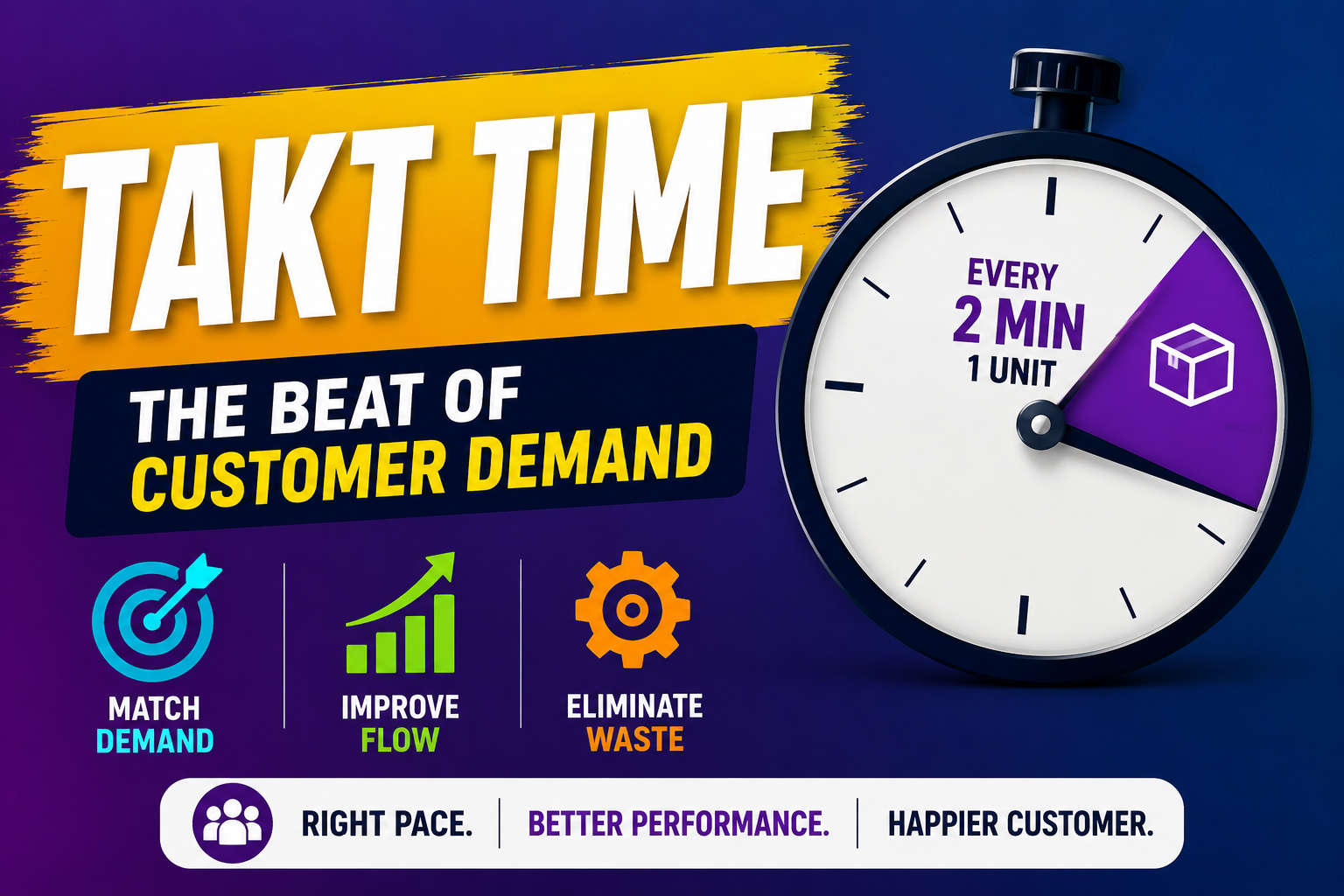
“Takt time is not a number on a whiteboard. It is the promise you make to your customer, delivered one unit at a time, at exactly the pace they need it.”
Introduction
In an orchestra, the conductor’s baton is very important. It doesn’t make any sound, but it guides all the musicians. Each person plays their own part, but follows the same timing and direction shown by the baton. It helps everyone stay together, so the music sounds smooth and in harmony, like one complete performance.
Read More: https://bit.ly/MUDA8Waste (Muda: 8 Wastages)
Read More: https://bit.ly/SMED- (SMED)
Read More: https://bit.ly/SMEDExample (SMED Example)
Objective and Significance of TAKT Time
In the world of manufacturing and lean production, few concepts are as fundamental, yet as widely misunderstood, as takt time. Derived from the German word Takt, meaning “beat” or “pulse,” takt time represents the rhythm at which a production system must operate to meet customer demand exactly. Not faster. Not slower. Just right.
Takt time on its own is just a number.
What You Will Learn
After reading the article, you will understand:
- The meaning of TAKT Time
- Why it is important
- The key steps involved
- An example of Takt Time
- The current challenges faced in the industry
Read More: https://bit.ly/MudaMuriMura (3M- Muda, Mura, Muri)
Read More: https://bit.ly/MuraMuri (Mura and Muri)
Read More: https://youtu.be/qoAvb6HnF-A (SWOT Analysis)
Definition:
Heijunka: It is the practice of smoothing and levelling production volume and product mix over a period of time to create a steady, predictable workflow.
SMED (Single Minute Exchange of Dies): It is a Lean method used to reduce machine changeover time so that switching from one product to another takes less than 10 minutes.
Standardised Work: it is the documented best method to perform a job safely, efficiently, and consistently using the least waste.
Takt time: It is the rate at which a product must be produced to meet customer demand.
Read More: https://youtu.be/F2zVsEbbILA (DOJO Room)
Read More: https://youtu.be/2e4ubL8eHns (Kaizen)
Detailed Information
From a German aviation scheduling tool in the 1930s to an AI-powered global manufacturing principle today, takt time has travelled nearly a century, growing in depth, reach, and sophistication with every decade. Its core idea, however, has never changed: produce at the pace of the customer, no more and no less.
Read more: https://youtu.be/bUGzXAQSsJU (5S)
Read More: https://youtu.be/MzzQFm9paJw (Quality Circle)
Why is TAKT Time?
Takt time answers one critical question: How often must we complete one unit of product to satisfy customer demand?
The formula is simple:
Takt Time = Available Production Time ÷ Customer Demand
For example, if a factory operates for 480 minutes per shift (after accounting for breaks and maintenance) and customers demand 240 units per shift, the takt time is:
480 ÷ 240 = 2 minutes per unit
This means one finished product must leave the line every 2 minutes. If a workstation takes 3 minutes, it is a bottleneck. If it takes 1 minute, it is running ahead of demand, potentially creating overproduction, one of lean manufacturing’s most serious wastes.
It is important to distinguish takt time from two related metrics:
- Cycle time is how long a process actually takes to complete one unit.
- Lead time is the total time from receiving an order to delivering it.
Takt time is the target, the pace at which production should be maintained.
Cycle time is the reality.
Closing the gap between the two is the ongoing challenge of lean manufacturing
Read More: https://youtu.be/3aeV9N8io4A (DWM- Daily Work Management)
Read More: https://youtu.be/4ZgUCVvgsWg (Fault Tree Analysis)
Why Takt Time Matters
Takt time is not merely a calculation. It is the foundation of an entire production philosophy. Here is why it holds such significance:
- Aligns Production with Real Demand. Without takt time, factories often operate on assumptions, producing as fast as machines allow, or as slowly as bottlenecks permit. Takt time replaces guesswork with precision, ensuring production is tied directly to what customers actually need.
- Exposes Waste Instantly. Any station operating above takt time is a problem. Any station running well below it is a source of idle time or overproduction. Takt time makes these imbalances immediately visible, giving managers a clear target for improvement.
- Enables Workforce Planning. Once takt time is known, staffing decisions become mathematical. If the total work content per unit is 600 seconds and the takt time is 60 seconds, exactly 10 workers are needed. When demand changes, the workforce can be rebalanced accordingly, reassigning workers to improvement projects rather than leaving them idle.
- Continuous Improvement Drives. Takt time creates a built-in feedback mechanism. When cycle time creeps above takt time, it triggers investigation. When a new process improvement brings cycle time below takt time, efficiency gains are quantified and celebrated. It transforms improvement from a vague goal into a measurable pursuit.
Read More: https://youtu.be/BeLWXihzdh0 (Difference Between PDCA and SDCA)
Read More: https://youtu.be/zqIQbPWlBf8 (Hoshin Kanri)
Real-World Application: Toyota’s Example
Toyota is one of the best examples of using takt time. Since the 1950s, it has made Takt time a core part of its production system. At its Kentucky plant, every step, from welding to final assembly, follows the same steady pace.
Toyota reviews takt time often based on demand. If demand increases, work speeds up. If it drops, workers focus on improvements instead of losing jobs.
This helps Toyota produce more cars with better quality and less waste. Other companies like BMW, Honda, and Ford have also used this approach to improve speed, quality, and cost.
Read More: https://youtu.be/jPXHLizqzM8 (Obeya Room)
Read More: https://bit.ly/3Gemba (3G: Genma, Genbutsu, Genjitsu)
Key Benefit
Takt time is important because it transforms a chaotic production environment into a disciplined, demand-driven system.
- reducing waste,
- improving efficiency, and
- ensuring customer satisfaction.
Read More: https://bit.ly/OEECalculation (What is OEE?)
Read More: https://bit.ly/PESTLEANALYSIS (What is PESTLE?)
Conclusion:
Takt time looks simple; it’s just one number. But it has a big impact. It connects every step of the work to what customers actually need. It also helps find problems and keeps the whole organisation moving at the right pace.
Companies like Toyota, BMW, and Honda don’t just calculate takt time and forget it. They build their way of working around it, making it part of daily habits and decisions.
For any manufacturer that wants to reduce waste, improve quality, and deliver better value, takt time is not a choice; it’s the starting point.
Read More: https://bit.ly/7ProblemSolvingTechnique (What is Problem Solving Technique?)
Read More: https://bit.ly/4MChanges (What is 4M change?)
Present Challenges:
Despite its power, sustaining takt time in real-world conditions is genuinely difficult. Studies suggest that while a large majority of manufacturers attempt to learn principles, only around 2% fully achieve their objectives, and fewer still sustain them long-term.
Several challenges make this hard:
Demand variability is perhaps the most persistent obstacle. Customer orders fluctuate daily, seasonally, and unpredictably. A takt time calculated on Monday may be outdated by Friday. Companies must build processes for rapid recalculation and line rebalancing.
Machine downtime is another disruptor. Unplanned breakdowns reduce available production time, instantly invalidating takt time calculations. Strong preventive maintenance programs, known as Total Productive Maintenance (TPM), are essential.
Skill gaps and workforce turnover undermine the consistency of takt time demands. If workers cannot reliably complete tasks within the required time, the rhythm collapses. Multi-skilling, standardised work instructions, and ongoing coaching are non-negotiable.
Cultural resistance may be the biggest barrier of all. Takt time requires discipline, transparency, and a willingness to stop the line when problems arise. In organisations where speed is prioritised over quality, or where leadership is not genuinely committed to lean principles, takt time quickly becomes just another number on a dashboard, ignored when inconvenient.
References:
IATF 16949
Toyota Production System
Industry Experts
This is the 251st article in my Quality Management series. Each weekend, I share practical insights designed to make your Management System journey more effective, efficient, and meaningful. If you find this useful, please share it with your colleagues as well.
As Albert Einstein wisely said, “The important thing is never to stop questioning.” So, feel free to ask anything related to today’s topic. Your questions spark learning for everyone. I will respond to every query to the best of my ability, and your personal information will always remain confidential.
Your honest feedback matters greatly. Do share your thoughts, and feel free to suggest topics you’d like me to cover in the coming weeks.
Excellent and very useful article
Thanks Vinai for the kind words.
Do share with those, whom you want to get benefitted.