“The most dangerous kind of waste is the waste we do not recognize.” – Shigeo Shingo
Introduction
In our daily lives, we constantly experience systems similar to Andon, where a signal alerts us to take immediate action.
When we start driving a car without wearing a seat belt, a buzzer sounds to remind us to fasten it. This ensures safety before continuing the journey.
Similarly, when we use an elevator and the number of passengers exceeds the approved weight limit, a warning buzzer is triggered and the lift stops operating. This prevents potential risk and ensures safe usage.
In the case of mobile phones, when the battery level drops, a red indicator warns us that the device needs to be recharged. This helps us avoid sudden shutdowns and disruption.
Even the human body functions in a similar way. It continuously gives signals when something is wrong, such as high blood pressure, low sugar levels, or lack of sufficient sleep, prompting us to take corrective action.
Read More: https://bit.ly/MudaMuriMura (3M- Muda, Mura, Muri)
Read More: https://bit.ly/MUDA8Waste (Muda: 8 Wastages)
Read More: https://bit.ly/SMED- (SMED)
Read More: https://bit.ly/SMEDExample (SMED Example)
Objective and Significance of ANDON
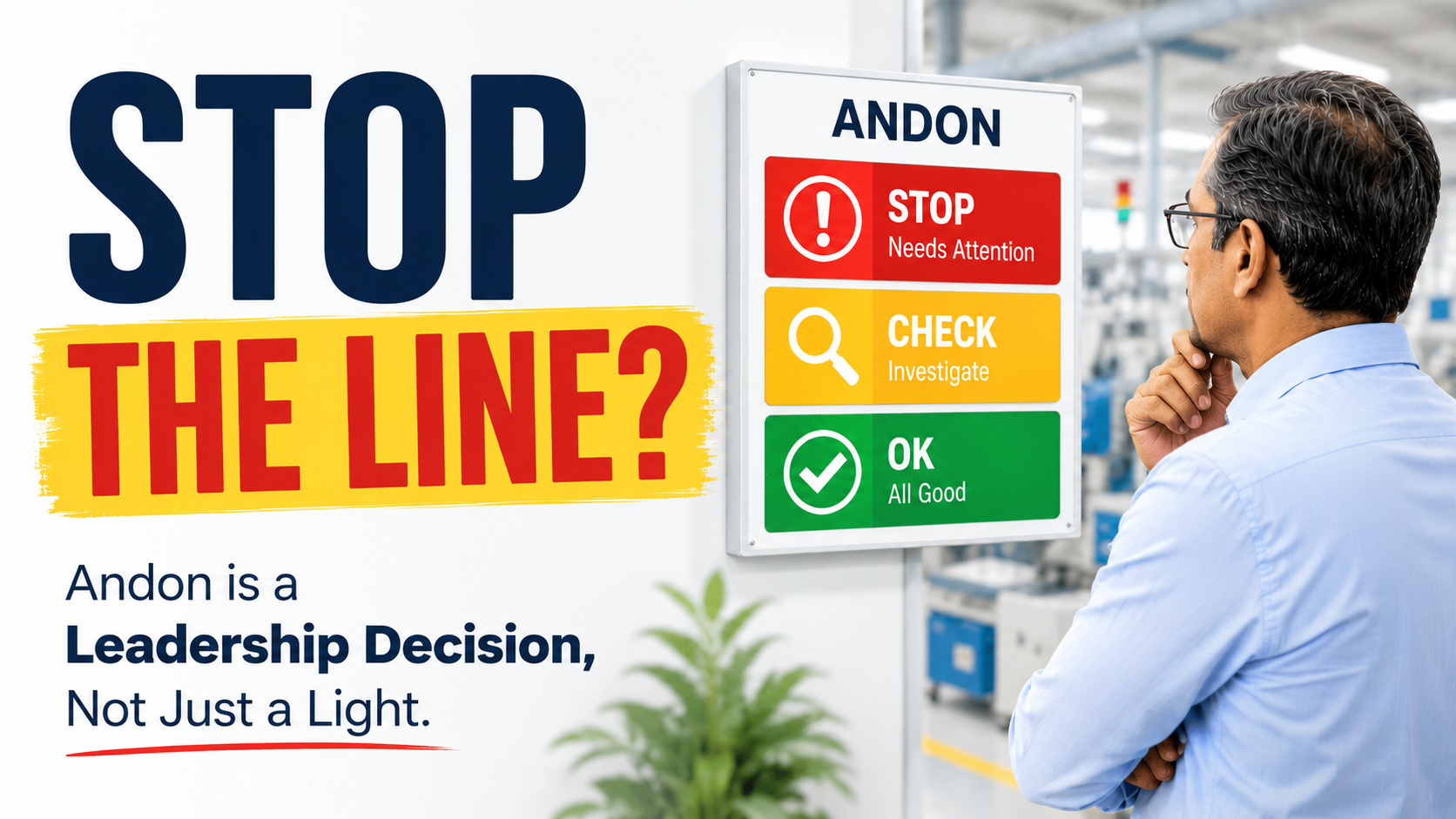
The objective of Andon is not to signal a problem, it is to ensure the problem is seen, stopped, and solved immediately.
It was not invented as a tool; it emerged as a necessity to make problems visible and solvable in real time.
In essence, Andon transforms operations from “produce at any cost” to “produce right the first time.”
What You Will Learn
After reading the article, you will understand:
- The meaning of ANDON System
- Why it is important
- The key steps involved
- Why Andon system is not so successful
- The current challenges faced in industry
Read More: https://bit.ly/MuraMuri (Mura and Muri)
Read More: https://youtu.be/qoAvb6HnF-A (SWOT Analysis)
Read More: https://bit.ly/TaktTimee (TAKT Time)
Definition:
Heijunka: It is the practice of smoothing and levelling production volume and product mix over a period of time to create a steady, predictable workflow.
SMED (Single Minute Exchange of Dies): It is a Lean method used to reduce machine changeover time so that switching from one product to another takes less than 10 minutes.
Standardised Work: it is the documented best method to perform a job safely, efficiently, and consistently using the least waste.
Takt time: It is the rate at which a product must be produced to meet customer demand.
Read More: https://youtu.be/F2zVsEbbILA (DOJO Room)
Read More: https://youtu.be/2e4ubL8eHns (Kaizen)
Detailed Information
The Andon system began in Japan in the late 1940s to early 1950s, as part of the development of the Toyota Production System.
The term ANDON comes from Japanese, where “Andon” (行灯) means a paper lantern. In factories, it refers to a signal light or display board that shows the status of operations.
The Andon system is a core part of the Toyota Production System, where workers can even pull an Andon cord to stop the entire production line if they detect a defect.
Read more: https://youtu.be/bUGzXAQSsJU (5S)
Read More: https://youtu.be/MzzQFm9paJw (Quality Circle)
How to Implement Andon System?
- Start with the Right Intent (Critical): Andon is for solving problems, not for monitoring people.
- Identify Pilot Area (Start Small): Choose one line / one process (high defect area, repetitive production, bottleneck process
- Define Clear Trigger Conditions: Keep it very simple (max 4–5 triggers) like Quality issue, Machine breakdown, Material shortage or Safety concern.
- Design Simple Signaling System: Light (Red/Yellow/Green) or buzzer, Manual button / pull cord.
- Define Response System (Most Important): Who responds? (Supervisor / Maintenance / Quality), Response time: < 2–5 minutes, Escalation if not resolved.
- Train & Build Confidence: Train operators: “You are allowed to stop the line”, Train supervisors: “Support, don’t blame”.
- Solve Root Cause (Not Just Firefighting): Each Andon call must lead to: Problem identification, Root cause analysis and Permanent fix.
- Track & Review Daily: Track simple metrics: Number of Andon calls, Response time and Repeat issues.
- Stabilize → Then Expand: First stabilize pilot area, then replicate to other lines.
Summary: Start Small → Respond Fast → Fix Permanently → Expand Gradually
“Andon is not implemented when lights are installed, it is implemented when people start responding without delay.”
Read More: https://youtu.be/3aeV9N8io4A (DWM- Daily Work Management)
Read More: https://youtu.be/4ZgUCVvgsWg (Fault Tree Analysis)
Why Andon System Matters
- Immediate problem visibility
Issues don’t stay hidden. The moment something goes wrong, everyone can see it. - Faster response time
Instead of delays or escalation layers, support teams react instantly. - Better quality control
Problems are fixed at the source, preventing defects from moving downstream. - Builds accountability culture
Operators are empowered to raise issues; this is a big cultural shift. - Continuous improvement
Repeated Andon signals highlight patterns, helping eliminate root causes over time.
Read More: https://youtu.be/BeLWXihzdh0 (Difference Between PDCA and SDCA)
Read More: https://youtu.be/zqIQbPWlBf8 (Hoshin Kanri)
Why Andon System is not so Successful?
Andon is widely adopted but rarely used to its full potential.
Most industries install Andon systems, but far fewer live them the way the Toyota Production System intended. The key reasons are
- No quick response: Signals get ignored
- Blame culture: Workers hesitate to raise issues
- Too many false alarms: System loses credibility
- No root cause analysis: Same problems repeat
“Organizations want the benefits of Andon, but not the discomfort of stopping production.”
Stopping a line feels like a loss, but in reality, it prevents bigger losses.
Read More: https://youtu.be/jPXHLizqzM8 (Obeya Room)
Read More: https://bit.ly/3Gemba (3G: Genma, Genbutsu, Genjitsu)
Key Benefit
Companies that treat Andon as a “system” get visibility.
Companies that treat it as a “discipline” get results.
- Improved Quality (First-Time-Right)
- Faster Problem Resolution
- Reduction in Downtime
- Better Flow & Productivity
- Employee Empowerment
- Strong Continuous Improvement (Kaizen)
- Visual Management & Transparency
- Cost Reduction
Andon does not improve performance directly; it exposes the truth.
Improvement comes from how honestly and quickly that truth is acted upon.
Read More: https://bit.ly/OEECalculation (What is OEE?)
Read More: https://bit.ly/PESTLEANALYSIS (What is PESTLE?)
Conclusion:
Andon is a visual management system used in manufacturing to signal problems in real time. It enables operators to alert issues immediately, ensuring quick response and resolution. Rooted in the Toyota Production System, its purpose is to stop defects, maintain flow, and drive continuous improvement through visibility, accountability, and timely problem-solving.
The effectiveness of Andon is not about technology; it’s about discipline and culture.
“Andon is not implemented when lights are installed, it is implemented when people start responding without delay.”
“Your line stops for eight minutes when ANDON is pulled. It bleeds for eight months when it is not.”
Read More: https://bit.ly/7ProblemSolvingTechnique (What is Problem Solving Technique?)
Read More: https://bit.ly/4MChanges (What is 4M change?)
Present Challenges:
- Output-first mindset: “Line should not stop” is still dominant thinking
- Cultural hesitation: Operators often avoid raising issues due to hierarchy
- Delayed response systems: Support teams are not always structured for quick action
- Weak root cause discipline: Problems are fixed temporarily, not eliminated
References:
IATF 16949
Toyota Production System
Industry Experts
This is the 252nd article in my Quality Management series. Each weekend, I share practical insights designed to make your Management System journey more effective, efficient, and meaningful. If you find this useful, please share it with your colleagues as well.
As Albert Einstein wisely said, “The important thing is never to stop questioning.” So, feel free to ask anything related to today’s topic. Your questions spark learning for everyone. I will respond to every query to the best of my ability, and your personal information will always remain confidential.
Your honest feedback matters greatly. Do share your thoughts, and feel free to suggest topics you’d like me to cover in the coming weeks.