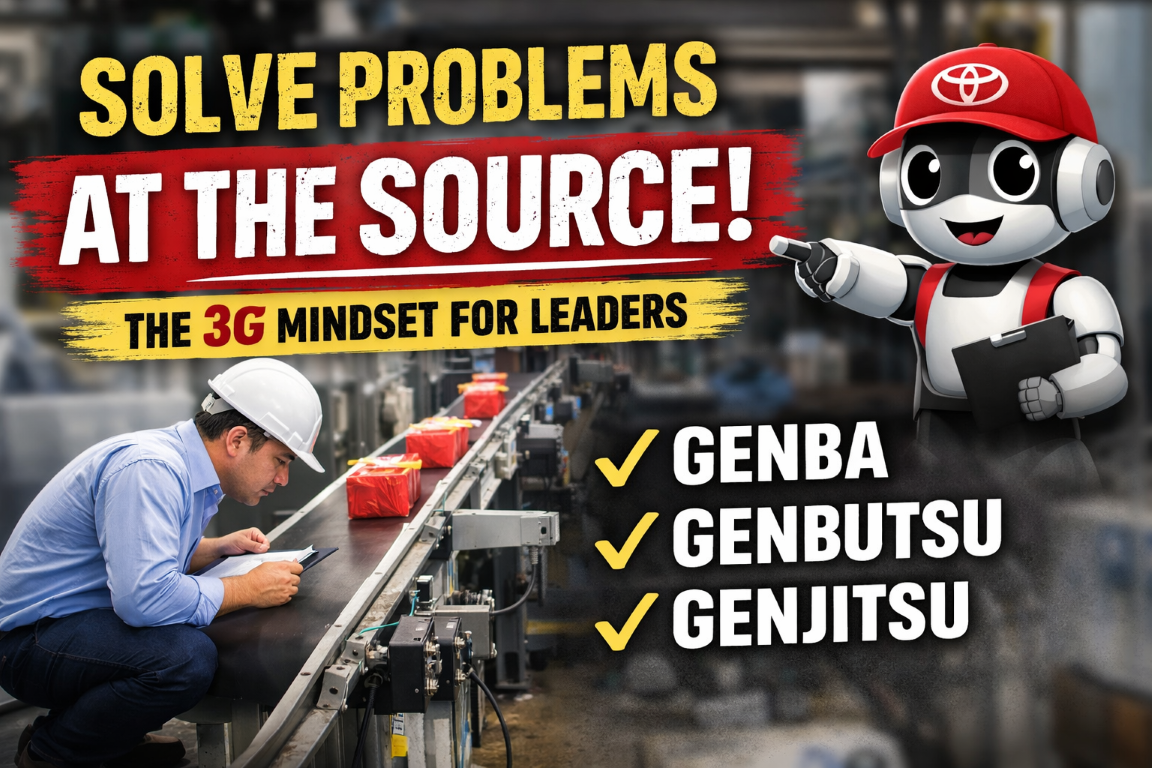
“Leaders don’t manage from conference rooms; they lead from the floor.” – Taiichi Ohno
Introduction
When Ram, Sita, and Lakshman were living in the forest during exile, Ravan kidnapped Sita. Lord Ram had two choices.
The easy choice was to simply ask Lakshman to go and search for her.
But instead, he chose a wiser path. First, he tried to understand who Ravan was and how powerful he was. After gathering this information, he sought help from Hanuman and Sugriv. Together, they built an army, marched to Lanka, and defeated Ravan to rescue Sita.
Content: 3G
- What is 3G?
- The key purpose of 3G
- Example of 3G implementation
- Key Benefits
- Key challenges
- Conclusion
Read More: https://youtu.be/4ZgUCVvgsWg (Fault Tree Analysis)
Read More: https://youtu.be/xbuD1FePP5s (Problem Solving Techniques)
Objective
The key objective of 3G is to drive accurate, evidence-based decisions by going to the source of the problem. For operations and supply chain leaders, it ensures stability, reliability, and long-term performance excellence.
3G: A Triad of Excellence. These are known as the 3 GEN Principles.
After reading the article, you will understand the meaning of 3G, its purpose, how to implement it, key benefits and key industry challenges.
Read Morehttps://youtu.be/-1jZVaAu-X8 (Causal Factors)
Read More: https://youtu.be/qoAvb6HnF-A (SWOT Analysis)
Definition: IATF 16949 Clause 3.1
Jidoka: As per the Toyota Production System, it means “automation with a human touch,” where human wisdom is added to automation.
Just-in-Time: Making only what is needed, when it is needed, and in the amount needed. Fulfilling orders from customers as quickly as possible.
Read More: https://youtu.be/F2zVsEbbILA (DOJO Room)
Read More: https://youtu.be/2e4ubL8eHns (Kaizen)
Detailed Information
Toyota promotes the concept of “Go and See” (Genchi Genbutsu), a management practice requiring managers to personally observe operations before making decisions.
3G is a foundation for Root Cause Analysis Tools, such as:
- 5 Why Analysis
- A3 Problem Solving
- Kaizen
- Quality Circle
- 8D analysis
It all begins with 3G thinking. Without seeing the real situation, Toyota believes root cause analysis becomes weak.
“Data from a report is secondary. Reality at the workplace is primary.”
Another concept, the management by wandering around (MBWA), also known as management by walking around, refers to a style of business management which involves managers wandering around, in an unstructured manner, through their workplace(s) at random, to check with employees, equipment, or the status of ongoing work.
Read more: https://youtu.be/bUGzXAQSsJU (5S)
Read More: https://youtu.be/MzzQFm9paJw (Quality Circle)
What is 3G?
3G (Gemba, Genbutsu, Genjitsu) is closely linked with Toyota because it is a foundational thinking principle within the Toyota Motor Corporation Production System (TPS).
Gemba (現場) – The Real Place
It means “the actual place” where work happens.
In manufacturing, this is the shop floor.
In business, it could be the warehouse, customer site, or service centre.
👉 Go to the place where the problem actually occurred.
Genbutsu (現物) – The Real Thing
It means “the actual object” involved in the problem.
For example:
- The defective part
- The broken machine
- The rejected product
👉 Look at the real item, not reports or photos.
Genjitsu (現実) – The Real Facts
It means “the actual data or facts.”
- Measured values
- Process parameters
- Actual observations
- Verified evidence
👉 Base decisions on facts, not opinions.
Read More: https://youtu.be/3aeV9N8io4A (DWM- Daily Work Management)
Key Purpose of 3G
The purpose of 3G is to “replace opinions with observations and assumptions with facts”.
The 3 GEN principles are the philosophy on which the 8-step problem-solving methodology is based. The former is philosophy, while the latter is the tools to implement this philosophy. We should not confuse one with the other. These 3 GEN principles are key to the successful implementation of any Kaizen event in an organisation.
The purpose of 3G – Gemba, Genbutsu, Genjitsu is to ensure that decisions are made based on direct observation, real objects, and verified facts, rather than assumptions, reports, or opinions.
This principle, strongly practised in the Toyota Motor Corporation Production System, builds a culture of disciplined and fact-based problem solving.
- To Identify the True Root Cause
- To Eliminate Assumptions
- To Improve Quality and Reliability
- To Build Leadership Credibility
- To Strengthen a Culture of Continuous Improvement
Read More: https://youtu.be/BeLWXihzdh0 (Difference Between PDCA and SDCA)
Read More: https://youtu.be/zqIQbPWlBf8 (Hoshin Kanri)
Example of 3G
A well-known industry example often shared in Quality Circles involves empty soap cartons at a packaging line for Lifebuoy, manufactured by Hindustan Unilever Limited.
🏭 The Problem
Customers complained that some soap boxes were reaching the market without the soap bar inside — only empty cartons.
This created:
- Customer dissatisfaction
- Brand reputation risk
- Rework and recall costs
🔎 Initial Reaction
Management first considered:
- Installing expensive X-ray machines
- Adding weight-check systems
- Increasing manual inspection
All complex and costly solutions.
🚶♂️ Applying 3G Thinking
Instead of relying only on reports, the team:
✅ Gemba – Went to the actual packaging line
They observed the conveyor system in real time.
✅ Genbutsu – Checked the actual empty cartons
They physically examined rejected and suspected boxes.
✅ Genjitsu – Verified real conditions
They noticed that occasionally, due to high conveyor speed, a soap bar would miss dropping into the carton, and the empty box continued moving forward.
💡 The Simple Solution
One operator suggested installing a simple high-speed fan near the conveyor.
Since empty cartons were lighter than filled ones,
👉 The fan would blow empty cartons off the line automatically.
Problem solved — low-cost, highly effective solution.
🎯 Key Learning
- The best solutions are often simple.
- Real observation prevents over-engineering.
- Shop-floor insight is powerful.
💬 In One Line:
When you go to the real place and see the real problem, the solution often becomes simple.
Read More: https://youtu.be/jPXHLizqzM8 (Obeya Room)
Key Benefit
- Prevents assumptions and guesswork
- Improves root cause analysis
- Builds a culture of accountability
- Strengthens problem-solving discipline
- Supports Lean and Quality Management practices
Read More: https://bit.ly/OEECalculation (What is OEE?)
Read More: https://bit.ly/PESTLEANALYSIS (What is PESTLE?)
Conclusion:
3G (Gemba, Genbutsu, Genjitsu) is a Japanese problem-solving principle widely practised by Toyota Motor Corporation.
It means:
- Gemba – Go to the actual place
- Genbutsu – See the actual object
- Genjitsu – Understand the actual facts
The core idea is simple: make decisions based on direct observation and real data, not assumptions or reports.
3G strengthens root cause analysis, improves quality, and builds a culture of disciplined, fact-based decision-making in operations and supply chains.
The biggest challenge in 3G implementation is changing the mindset from report-driven management to reality-driven leadership.
Read More: https://bit.ly/7ProblemSolvingTechnique (What is Problem Solving Technique?)
Read More: https://bit.ly/4MChanges (What is 4M change?)
Present Challenges:
- How often is root cause analysis based on the real issue on the shop floor rather than confirmation bias (to search for, interpret, and remember information in a way that confirms our existing beliefs, while ignoring or dismissing contradictory evidence)?
- How often, due to time pressure and firefighting culture, organisations look for Quick fixes instead of root cause analysis, making decisions in meeting rooms and skipping physical verification.
References:
IATF 16949
Toyota Production System
Industry Experts
This is the 245th article in my Quality Management series. Each weekend, I share practical insights designed to make your Management System journey more effective, efficient, and meaningful. If you find this useful, please share it with your colleagues as well.
As Albert Einstein wisely said, “The important thing is never to stop questioning.” So, feel free to ask anything related to today’s topic. Your questions spark learning for everyone. I will respond to every query to the best of my ability, and your personal information will always remain confidential.
Your honest feedback matters greatly. Do share your thoughts, and feel free to suggest topics you’d like me to cover in the coming weeks.