“The more inventory a company has, the less likely they will have what they need.” – Taiichi Ohno
Introduction
Whenever we go to the market to buy groceries, we naturally create a mental plan before we start shopping. Based on our shopping list, we decide the order in which we will visit different shops to complete our purchases efficiently. We also consider which items are likely to be the heaviest and usually buy them last to avoid carrying unnecessary weight when moving from one shop to another.
Sometimes, we even consider where discounts are available and choose a time when the shops are likely to be less crowded, making the entire shopping experience quicker, easier, and more economical.
Read More: https://bit.ly/SMED- (SMED)
Read More: https://bit.ly/SMEDExample (SMED Example)
Objective and Significance of the Milk Run System
A milk run is not just a transportation method; it is a commitment to delivering the right material, in the right quantity, at the right time, with the least possible waste.
Read More: https://bit.ly/MuraMuri (Mura and Muri)
Definition:
Heijunka: It is the practice of smoothing and levelling production volume and product mix over a period of time to create a steady, predictable workflow.
SMED (Single Minute Exchange of Dies): It is a Lean method used to reduce machine changeover time so that switching from one product to another takes less than 10 minutes.
Standardised Work: it is the documented best method to perform a job safely, efficiently, and consistently using the least waste.
Takt time: It is the rate at which a product must be produced to meet customer demand.
Read More: https://youtu.be/F2zVsEbbILA (DOJO Room)
Read More: https://bit.ly/AndonSysstem (Andon System)
Business Challenge
As a business owner, we want to increase profits, improve cash flow, and keep customers happy. However, many times, we lose a significant amount of money without even realising it. The problem is often not a lack of sales, but an inefficient supply chain.
Consider a case where production is running as planned, suppliers are delivering on time, and customer demand is steady. Even then,
- transportation costs keep increasing,
- warehouses remain full,
- money stays tied up in inventory, and
- Production lines occasionally stop because the right material is not available at the right time.
These may seem like separate problems, but they all point to one common issue: poor material flow.
Instead of asking, “How can we move more materials?”, we should ask, “How can we move materials more smartly and efficiently?”
This is where the Milk Run System becomes much more than a transportation method. It becomes a business strategy.
Read More: https://bit.ly/MudaMuriMura (3M- Muda, Mura, Muri)
Read More: https://bit.ly/MUDA8Waste (Muda: 8 Wastages)
Hidden Cost to the Organisation
Most organisations carefully track visible costs such as
- fuel,
- freight charges, and
- transportation expenses.
However, the biggest losses are often hidden.
- When every supplier sends a separate truck, transportation costs increase. Many trucks travel only partially loaded, which means the company pays more without getting any additional value.
- Large inventories create another hidden cost. They occupy warehouse space and lock up working capital that could otherwise be invested in new products, better technology, or business growth.
- Irregular deliveries also force production teams to maintain extra safety stock. Although this may seem like a solution, it only hides the real problem instead of solving it.
The impact does not stop there. Delayed materials affect
- Production schedules,
- Longer lead times reduce customer satisfaction, and
- Poor coordination between suppliers and the factory increases business risk.
Over time, these hidden costs slowly reduce profitability, even when sales continue to grow.
Possible Root Cause
The real problem is not transportation itself. The problem is that transportation is often managed separately instead of being connected to the overall business system.
Each supplier plans deliveries independently. Trucks arrive at different times, many are only partly filled, and deliveries are based on supplier convenience rather than production needs.
As a result, one area may have excess inventory while another faces shortages.
Lean thinking teaches us that
- unnecessary movement,
- waiting time, and
- excess inventory
are all forms of waste. Instead of adding more trucks or building bigger warehouses, organisations should improve the flow of materials.
The Lean Solution: Milk Run System
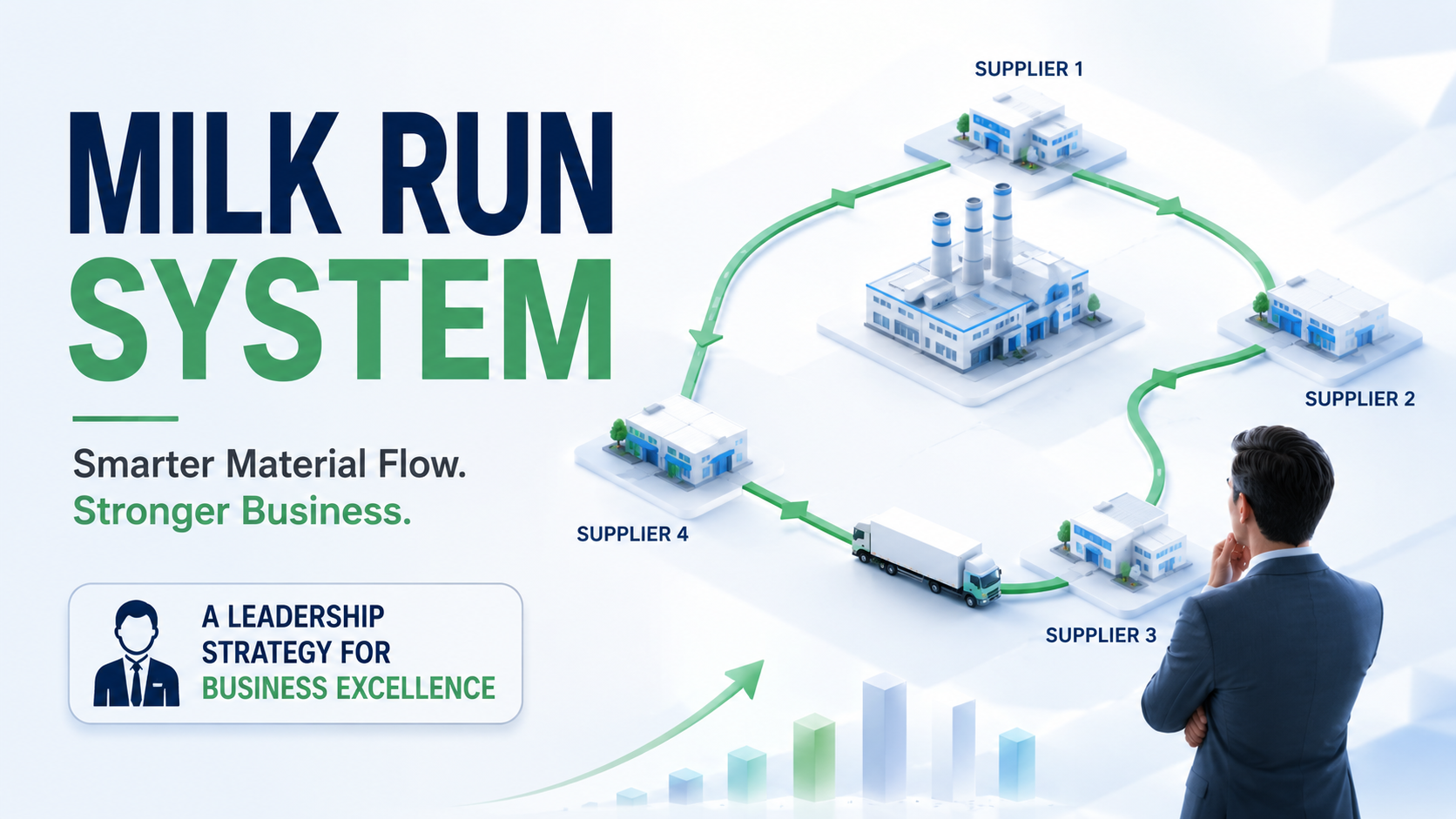
The Milk Run System is a Lean logistics approach that matches material movement with production requirements.
Instead of several suppliers sending separate vehicles to the factory, one vehicle follows a fixed route and schedule. It collects smaller quantities of material from multiple suppliers during a single trip.
The same idea can also be used inside the factory. A vehicle follows a fixed route and regularly delivers materials from the warehouse to different production lines.
The goal is not simply to reduce transportation costs. The real objective is to create a smooth, predictable, and continuous flow of materials that supports Just-in-Time production.
When materials move smoothly, the entire supply chain becomes more efficient.
Read more: https://youtu.be/bUGzXAQSsJU (5S)
Read More: https://youtu.be/MzzQFm9paJw (Quality Circle)
Business Benefits
The success of a Milk Run System can be measured by the following 3 key business results.
- Reduce Inventory: Frequent deliveries reduce inventory, which releases working capital and improves cash flow. Better vehicle utilisation lowers transportation costs without affecting customer service.
A fixed delivery schedule improves
- Production planning,
- Reduces interruptions, and
- Strengthens coordination with suppliers.
- On-time Delivery: Customers receive products on time, while the organisation becomes more flexible in responding to changing market demand.
- Business Resilience: When material flow is well organised, leaders can make faster decisions, respond quickly to disruptions, and manage the supply chain with greater confidence.
These improvements not only reduce costs but also create a long-term competitive advantage.
Read More: https://bit.ly/3Gemba (3G: Genma, Genbutsu, Genjitsu)
Read More: https://bit.ly/TaktTimee (TAKT Time)
Real-World Case Study
An automotive manufacturer purchased components from 8 nearby suppliers. Although production demand was stable, logistics costs continued to increase.
Each supplier arranged its own deliveries, resulting in several partially loaded trucks arriving throughout the day. The factory maintained more than 3 days of inventory, warehouses became crowded, and production occasionally stopped because some critical parts were delayed.
Instead of buying more trucks or expanding warehouse space, the company redesigned its logistics process using the Milk Run System.
One vehicle followed a fixed route and collected materials from all suppliers several times a day. Suppliers adjusted their production schedules to match the collection timings, and the factory reduced its inventory levels.
Within six months, transportation costs fell by about 25%. Inventory was reduced by nearly 40%, warehouse space became available for productive activities, and material availability improved significantly. Most importantly, customer deliveries have become more reliable.
The company did not achieve these results by investing in more resources. It achieved this by using its existing resources more intelligently.
Read More: https://youtu.be/3aeV9N8io4A (DWM- Daily Work Management)
Read More: https://bit.ly/Jidokaa (What is Jidoka)
Lesson Learned
Great organisations do not become successful simply by buying more trucks, building bigger warehouses, or increasing inventory.
They succeed because they create systems that allow materials, information, and decisions to flow smoothly throughout the business.
The Milk Run System reminds us of an important leadership principle: sustainable competitive advantage comes not from working harder, but from designing smarter business processes.
Read More: https://youtu.be/zqIQbPWlBf8 (Hoshin Kanri)
Read More: https://youtu.be/jPXHLizqzM8 (Obeya Room)
Conclusion:
As a business leader, I should ask 3 simple questions:
- How much of our working capital is locked in unnecessary inventory?
- How many transportation trips add cost without adding value?
- Is our supply chain designed for individual department efficiency, or for overall business performance?
The companies that will lead in the future will not necessarily be the ones with the largest warehouses or the biggest transportation fleets. They will be the organisations that create the smoothest flow of materials, information, and value.
The Milk Run System is not just a logistics practice. It is a smarter way of running a business, one that improves profitability, strengthens resilience, and supports long-term business excellence.
Read More: https://bit.ly/HeijunkavsTaktTime (Difference between Heijunka and Takt Time)
Read More: https://bit.ly/OEECalculation (What is OEE?)
References:
IATF 16949
Toyota Production System
Industry Experts
This is the 255th article in my Quality Management series. Each weekend, I share practical insights designed to make your Management System journey more effective, efficient, and meaningful. If you find this useful, please share it with your colleagues as well.
As Albert Einstein wisely said, “The important thing is never to stop questioning.” So, feel free to ask anything related to today’s topic. Your questions spark learning for everyone. I will respond to every query to the best of my ability, and your personal information will always remain confidential.
Your honest feedback matters greatly. Do share your thoughts, and feel free to suggest topics you’d like me to cover in the coming weeks.
The topics shared are very relevant and are very important to progress in business and face the future challenges.👍👍
Thanks Ashok for your kind words and appreciation