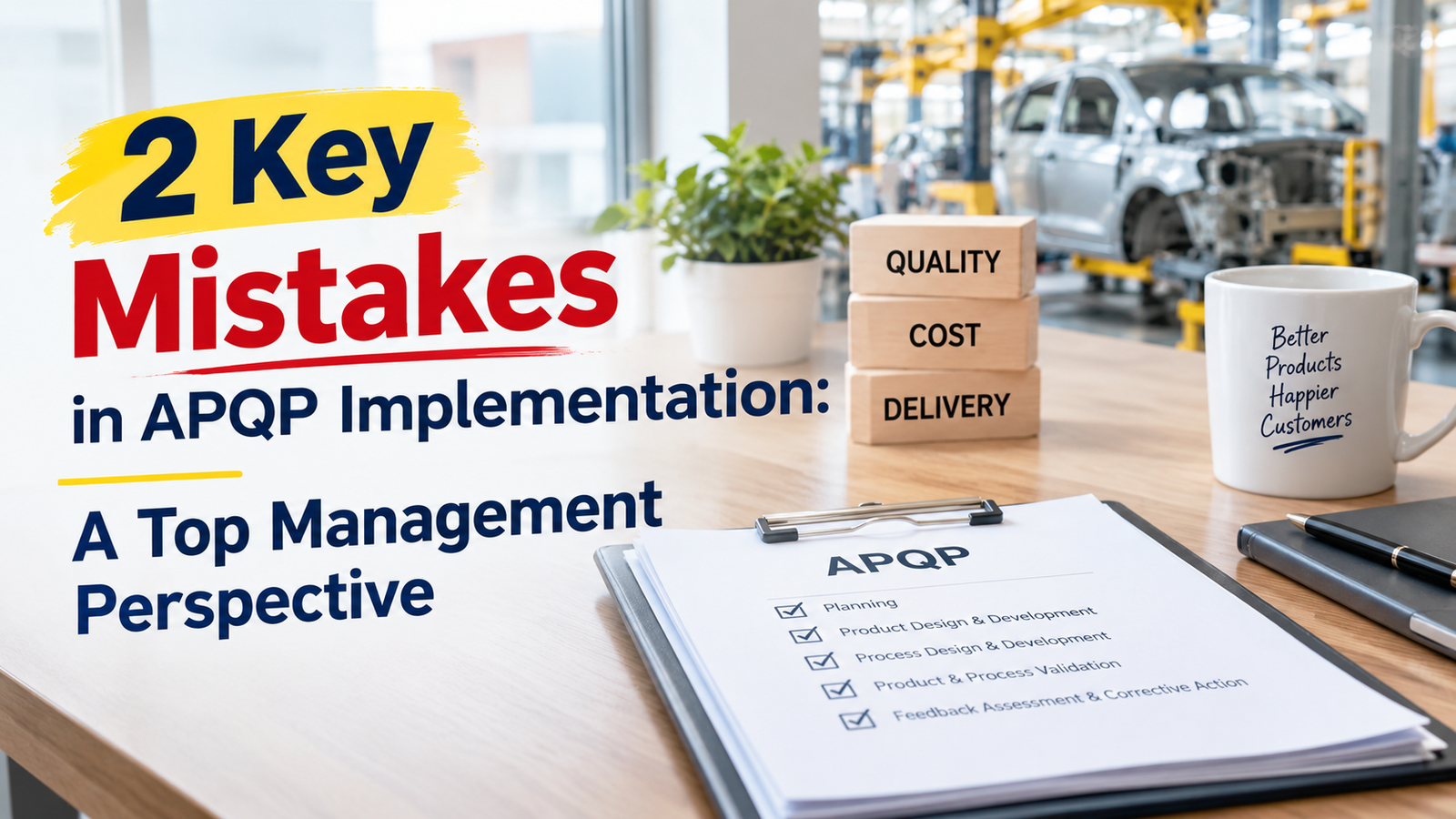
“A successful product launch is not the result of completed paperwork, but of risks understood, decisions made, and actions implemented.”
Introduction
At home, when we are preparing for a marriage, we make a detailed list and meticulously work on it. On the day of marriage, during the garland ceremony, if the flower garlands are missing, we feel that our efforts have not yielded the right result, as we missed the most important aspect of the marriage.
Objective and Significance
The key objective of the article is to help Top Management understand the distinct role of APQP process and use their outputs for better quality and business decisions.
APQP is not a tool to create documents but it is a structured approach to identify the possible risks and prevent them before they occur.
Read More: https://youtu.be/W1dq3L8FOJc (Customer Complaint Management)
Definition: IATF 16949
APQP (Advance Product Quality Planning): product quality planning process that supports development of a product or service that will satisfy customer requirements; APQP serves as a guide in the development process and also a standard way to share results between organizations and their customers; APQP covers design robustness, design testing and specification compliance, production process design, quality inspection standards, process capability, production capacity, product packaging, product testing and operator training plan, among other items.
Read More: https://youtu.be/eBP7noTTOeo (Control of NC Products)
Every automotive company has experienced it.
The APQP review is complete.
The customer approves the launch.
SOP begins.
Then come the customer complaints, premium freight, firefighting meetings, and unexpected costs.
What went wrong?
Usually not the documents. Usually the risks.
Because APQP is being treated as paperwork instead of risk management.
Each of these issues consumes management attention, erodes profit margins, and damages customer confidence.
Ironically, these issues often occur even when every required APQP document has been completed.
The problem isn’t the lack of documentation. The problem is how APQP is being implemented. They struggle because they lose sight of APQP’s real purpose: managing risk before it becomes a launch issue.
Read More: https://youtu.be/2e4ubL8eHns (KAIZEN)
Read More: https://youtu.be/sPtwvL1igLE (Final Inspection)
Here are the two biggest mistakes that are common across the automotive industry.
Mistake #1: Treating APQP as a Documentation Exercise instead of Risk Management
APQP documents are not the output. Risk mitigation is the output. Documents are merely evidence that structured thinking takes place.
Many teams focus on completing PFMEAs, Control Plans, Process Flows, and other APQP deliverables. While these documents are important, they are not the objective.
Risk mitigation is the objective. Documents are only evidence that the right thinking has taken place.
When APQP becomes a compliance activity, organisations often face:
- Late engineering changes
- Cost overruns
- Launch delays
- Customer complaints
- Warranty issues
A completed APQP file does not guarantee a successful launch. A robust risk management process does.
Read More: https://bit.ly/JobSetUpvsFPI (Difference Between FPI and Job Setup)
Mistake #2: Running APQP Within a Function Instead of Across the Business
“Individually we are one drop. Together we are an ocean.” – Ryunosuke Satoro
Launch failures rarely originate from one department. They occur when Engineering, Manufacturing, Quality, Supply Chain, Purchasing, and Program Management work in silos.
Each function sees different risks:
- Manufacturing understands process limitations.
- Quality understands failure modes.
- Supply Chain understands sourcing and logistics risks.
- Engineering understands product requirements.
Without true cross-functional collaboration, critical risks remain hidden until SOP (Start of Production), when fixing them becomes expensive.
Most launch failures are not technical failures. They are communication failures between functions.
Read More: https://youtu.be/QetaKIrQB5A (OEE)
Role of Leadership:
The biggest APQP failures are often leadership failures.
If leaders ask: “Are the APQP documents complete?”
Teams focus on paperwork.
If leaders ask: “What are the top launch risks, and how are we mitigating them?”
Teams focus on outcomes.
Read More: https://youtu.be/Zi7UzM59Muw (Reaction Plan)
Read More: https://bit.ly/SPCvsMSA (Difference SPC and MSA)
How to Know Whether Your APQP Process Is Actually Working:
Instead of documenting status, track QCD – Quality, Cost and Delivery:
- On-time launch performance
- Customer PPM
- Open high-risk issues before SOP
- Launch cost vs. budget
- Customer complaints during launch
- Repeat business awards
Read More: https://youtu.be/ZNlr1yEpVbw (SMED)
Conclusion
The purpose of APQP is not to create documents.
The purpose of APQP is to prevent surprises.
Organisations that focus on paperwork achieve compliance.
Organisations that focus on risk management achieve profitable launches, stronger customer trust, and sustainable growth.
Read More: https://youtu.be/pJ2Pg6UH6RI (4M Change)
References:
IATF 16949
APQP Manual
Industry Experts
This is the 261st article in my Quality Management series. Each weekend, I share practical insights designed to make your Management System journey more effective, efficient, and meaningful. If you find this useful, please share it with your colleagues as well.
As Albert Einstein wisely said, “The important thing is never to stop questioning.” So, feel free to ask anything related to today’s topic. Your questions spark learning for everyone. I will respond to every query to the best of my ability, and your personal information will always remain confidential.
Your honest feedback matters greatly. Do share your thoughts, and feel free to suggest topics you’d like me to cover in the coming weeks.