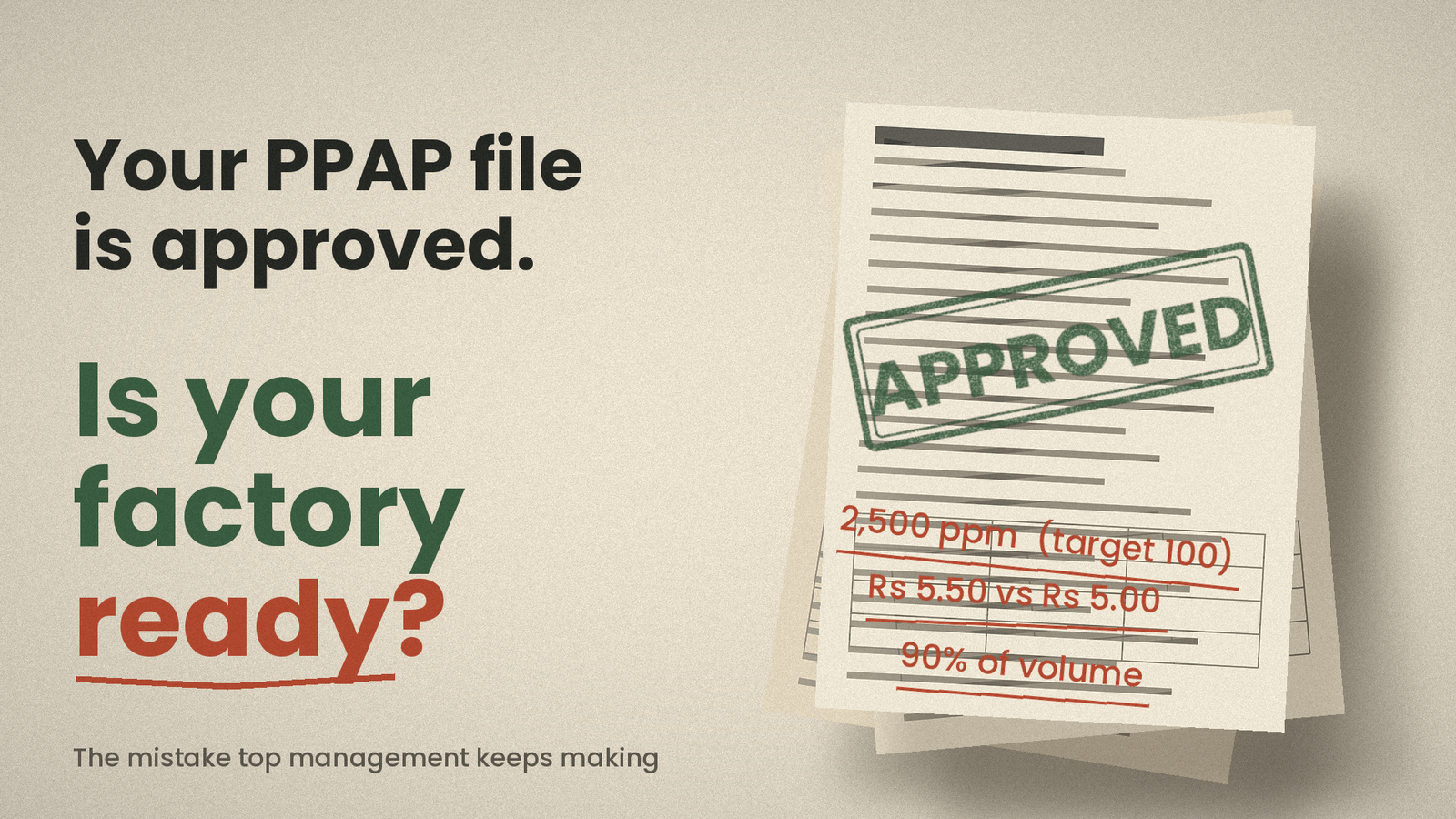
“The customer approves your PPAP. The market approves your performance.”
Introduction
When a student prepares for a competitive examination, they may have access to the complete syllabus, all necessary study materials, and even a well-structured study timetable.
However, do these things alone guarantee success in the examination?
Not necessarily.
Success depends on more than just having the right resources and plans. The student must also possess the capability, discipline, preparedness, and execution required to perform effectively on the day of the examination.
Objective and Significance
The purpose of the Production Part Approval Process (PPAP) is to provide objective evidence that a supplier understands customer requirements and has a capable, controlled manufacturing process that consistently delivers products meeting all specified requirements.
But when mass production begins, the organisation often does not achieve the required production volume. Rejection rates are much higher than expected. Manufacturing costs exceed the target. And some applicable legal requirements have not even been assessed.
Why does it happen?
Read More: https://youtu.be/W1dq3L8FOJc (Customer Complaint Management)
Read More: https://bit.ly/APQP2Mistakes (2 Key Mistakes in APQP Process)
Definition: IATF 16949
APQP (Advance Product Quality Planning): product quality planning process that supports development of a product or service that will satisfy customer requirements; APQP serves as a guide in the development process and also a standard way to share results between organisations and their customers; APQP covers design robustness, design testing and specification compliance, production process design, quality inspection standards, process capability, production capacity, product packaging, product testing and operator training plan, among other items.
Read More: https://youtu.be/eBP7noTTOeo (Control of NC Products)
The purpose of the Production Part Approval Process (PPAP) is to provide objective evidence that a supplier fully understands customer requirements and has a capable and controlled manufacturing process that can consistently deliver products meeting all specified requirements.
From a leadership perspective, PPAP serves a much broader purpose than customer approval. It should provide confidence to both the customer and the organization’s management that:
- Customer requirements have been fully understood.
- The organisation can consistently meet Quality, Cost, and Delivery (QCD) requirements through a capable and controlled manufacturing process.
These two objectives are closely linked. When an organisation truly understands customer requirements, both technical and system-related, it is far more likely to achieve the expected QCD performance.
Unfortunately, in many organisations, PPAP has become a documentation exercise. The focus shifts toward preparing and submitting a large package of documents rather than verifying whether the organisation is genuinely ready to meet customer expectations. As a result, PPAP may be completed and approved, yet fail to deliver the confidence and risk mitigation it was originally intended to provide.
Here are the two biggest mistakes that are common across the automotive industry.
Read More: https://youtu.be/2e4ubL8eHns (KAIZEN)
Mistake #1: Approving PPAP Without Ensuring Organisational Readiness
The purpose of internal PPAP approval should not be to confirm document completion. Its purpose should be to verify organisational readiness for sustained production.
Before approving PPAP, leadership should have confidence that the organisation can achieve:
- Required production capacity
- Target quality performance
- Agreed cost objectives
- Applicable legal and regulatory requirements
Example: Moulded Component (250T Machine, 2 Cavities)
| Parameter | Customer requirement | Mass production trial result |
| Volume | 2,000 per day over 2 shifts
(50,000 per month) |
1,800 in 2 shifts
(90% of target) |
| Internal rejection | 100 ppm | 2,500 ppm
(25 times the target) |
| Cost of Production | INR 5.00 per piece | INR 5.50 per piece |
| Legal | Compliance with Extended Producer Responsibility for Plastic Waste Management Rules | No awareness yet |
These results clearly indicate that the process is not yet production-ready.
Read More: https://bit.ly/JobSetUpvsFPI (Difference Between FPI and Job Setup)
Business Implications
Capacity Risk
- Customer demand cannot be met using the planned resources.
- Additional shifts, overtime, or investments may become necessary.
Quality Risk
- Higher rejection rates increase scrap, rework, and customer risk.
- Cost of Poor Quality (COPQ) rises significantly.
Profitability Risk
- Production cost increases from INR 5.00 to INR 5.50 per part.
- The customer is unlikely to absorb the additional cost, directly impacting profitability.
Compliance Risk
- Lack of awareness regarding legal requirements exposes the organisation to potential regulatory penalties and reputational damage.
If management approves this PPAP, the submission goes to the customer with the document file complete, but the organisation is not ready to supply the part profitably. The problems then surface after the start of production (SOP), where they cost the most to fix and damage customer trust.
Read More: https://youtu.be/sPtwvL1igLE (Final Inspection)
What Management should do
- Hold the internal approval until the trial results meet the targets, or until a time-bound corrective action plan is in place (cycle time reduction, defect root cause analysis, cost review, legal compliance plan).
- Repeat the trial after the corrective actions to confirm the improvement.
- Release PPAP to the customer only when capacity, quality, cost and legal readiness are demonstrated.
Read More: https://youtu.be/QetaKIrQB5A (OEE)
Mistake #2: Treating PPAP as a Quality Department Responsibility
Another common leadership mistake is assigning PPAP ownership exclusively to the Quality function.
When PPAP is viewed as a Quality responsibility, the objective often becomes document compliance rather than business readiness.
The outcome is often:
- Complete documentation
- Customer approval
- Poor launch performance
- Delivery disruptions
- Unexpected quality issues
- Cost overruns
- Significant firefighting after SOP
However, PPAP is the culmination of cross-functional planning and validation. Success depends on the contribution of multiple functions.
Read More: https://bit.ly/SPCvsMSA (Difference SPC and MSA)
Who should own what
| Function | Contribution |
| Engineering | Customer requirements, design and process requirements, process capability |
| Purchasing | Sub-supplier readiness, material cost and delivery |
| Production | Capacity, cycle time, yield |
| Maintenance | Tooling and equipment readiness |
| Finance | Cost targets and cost of poor quality |
| Legal / EHS | Statutory and regulatory compliance |
| Quality | Coordination, measurement systems, validation and documentation |
When these functions actively contribute, the organisation gains confidence that planned results can be achieved.
Read More: https://youtu.be/Zi7UzM59Muw (Reaction Plan)
What Management should do
- Appoint a cross-functional team with a named lead and clear responsibilities.
- Hold a formal readiness review before PPAP approval, in which each function confirms readiness against its own targets.
- Make top management sign-off the final gate, based on the evidence rather than the file.
Read More: https://youtu.be/ZNlr1yEpVbw (SMED)
Conclusion
The two biggest PPAP mistakes are not found in the PPAP file itself:
- Approving PPAP without verifying organisational readiness to meet Quality, Cost, Delivery, and Compliance objectives.
- Treating PPAP as a Quality department activity instead of a cross-functional business readiness process.
Organisations that avoid these mistakes use PPAP as a leadership tool to validate operational readiness. Those that do not often achieve PPAP approval while still experiencing launch failures, cost overruns, customer complaints, and profitability challenges.
A completed PPAP file does not, by itself, demonstrate organisational readiness. The real test is whether the organisation can consistently deliver conforming parts in the required quantity, at the expected cost, and in compliance with applicable requirements.
Read More: https://youtu.be/pJ2Pg6UH6RI (4M Change)
References:
IATF 16949
APQP Manual
PPAP Manual
Industry Experts
This is the 262nd article in my Quality Management series. Each weekend, I share practical insights designed to make your Management System journey more effective, efficient, and meaningful. If you find this useful, please share it with your colleagues as well.
As Albert Einstein wisely said, “The important thing is never to stop questioning.” So, feel free to ask anything related to today’s topic. Your questions spark learning for everyone. I will respond to every query to the best of my ability, and your personal information will always remain confidential.
Your honest feedback matters greatly. Do share your thoughts, and feel free to suggest topics you’d like me to cover in the coming weeks.