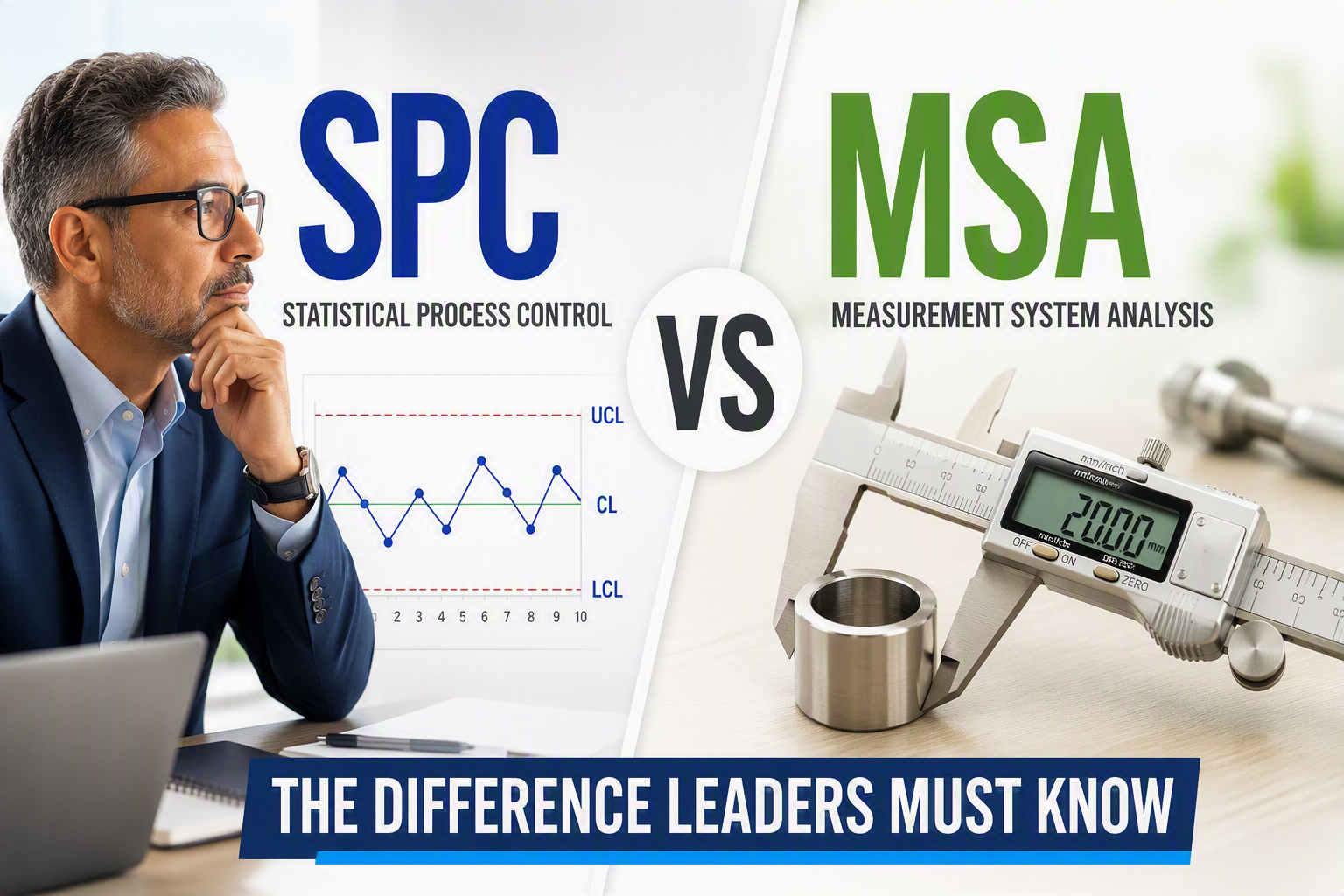
“Good data is not enough. Management must first know that the data can be trusted.”
Introduction
Social media shows vacations, parties, and happy moments. But behind the perfect pictures, reality can be very different. Some people smiling together today may not even be on speaking terms tomorrow.
Objective and Significance
The key objective of the article is to help Top Management understand the distinct roles of MSA and SPC and use their outputs for better quality and business decisions.
MSA and SPC are not statistical tools used only by Quality, but management tools that support fact-based decisions, early risk detection and customer confidence.
Read More: https://youtu.be/W1dq3L8FOJc (Customer Complaint Management)
Definition: ISO 9000
Non-Conformity: Non-fulfilment of a requirement
Defect: Non-conformity related to an intended or specified use
Conformity: Fulfilment of a requirement
Capability: Ability of an object to realise an output that will fulfil the requirements for that output.
Read More: https://youtu.be/eBP7noTTOeo (Control of NC Products)
A customer complaint has been received about a critical product dimension. The Quality team checks the control chart and finds that the process appears stable. Capability results are also acceptable.
Everyone is comfortable until one question is asked:
“Can we trust the measurement on which these conclusions are based?”
An MSA study then reveals that the measurement system itself is contributing an unacceptable level of variation.
This simple situation highlights an important point: good-looking data does not always mean good information.
Read More: https://youtu.be/2e4ubL8eHns (KAIZEN)
MSA: Can We Trust the Data?
MSA evaluates whether the measurement system is suitable and reliable for its intended purpose. It considers factors such as the gauge, operator, method, fixture and environment.
The important question is simple:
“Can we confidently make decisions based on this measurement?”
If the measurement system is not reliable, even sophisticated analysis can lead to the wrong conclusion.
Read More: https://youtu.be/sPtwvL1igLE (Final Inspection)
SPC: What Is the Process Telling Us?
SPC uses reliable measurement data to monitor process behaviour over time.
A process may produce parts within specification today, but its behaviour may be changing. Control charts can reveal trends, shifts or unusual variations before they become significant problems.
- SPC provides an early warning system.
Read More: https://bit.ly/JobSetUpvsFPI (Difference Between FPI and Job Setup)
A Simple Example
Consider a brake disc with a thickness requirement of 20.00 ± 0.10 mm.
First, MSA is used to establish confidence in the measurement system.
Once reliable data is available, SPC is used to monitor the process.
If the control chart shows a gradual increase in thickness, although the parts are still within specification.
Investigation identifies tool wear as the cause.
The organisation has therefore identified a potential problem before it becomes a customer problem.
Process Capability answers a different question:
“Can this stable process consistently meet the specification?”
Measures such as Cp and Cpk can support this evaluation.
Therefore, the logical thinking can be kept simple:
Reliable Measurement → Stable Process → Capability → Action
Each answers a different question, and none should be confused with the other.
Read More: https://youtu.be/QetaKIrQB5A (OEE)
Key Difference Between MSA and SPC
| Aspect | MSA | SPC |
| Purpose | Checks whether the measurement system is reliable | Monitors process behaviour over time |
| Focus | Measurement variation | Process variation |
| Key question | Can we trust the measurement? | Is the process stable and predictable? |
| Typical tools | Gage R&R, Bias, Linearity, Stability | Control charts |
| Management value | Confidence in the data | Early visibility of process changes |
| Input | Product/process measurements. | Measuring instruments and operators. |
| Output | Process performance and stability status. | Measurement system capability and acceptability. |
| Application Stage | During production process monitoring. | Before using measurement data for analysis and decisions. |
Read More: https://youtu.be/Zi7UzM59Muw (Reaction Plan)
Importance of MSA and SPC for the Top Management
Rather than looking only at Cpk, PPM or control charts, ask:
- Can we trust the measurement behind this data?
- What is the process trend telling us?
- Can the process consistently meet customer requirements?
- What action are we taking before the customer experiences the problem?
The objective is not to create more statistical reports. It is to ensure that quality data leads to the right business decisions at the right time.
Read More: https://youtu.be/ZNlr1yEpVbw (SMED)
Conclusion
MSA ensures that the organisation is collecting trustworthy data. SPC ensures that the production process remains stable and predictable. Together, they create the foundation for informed decision-making, operational excellence, and customer satisfaction.
A simple way to remember the distinction is:
MSA asks, “Can we trust the numbers?”
SPC asks, “What are the numbers telling us about the process?”
Organisations that master both disciplines spend less time reacting to problems and more time driving continuous improvement, sustainable growth, and competitive advantage. This is why every senior leader, not just quality professionals, should clearly understand the difference between SPC and MSA.
Read More: https://youtu.be/pJ2Pg6UH6RI (4M Change)
References:
IATF 16949
SPC Manual
MSA Manual
Industry Experts
This is the 260th article in my Quality Management series. Each weekend, I share practical insights designed to make your Management System journey more effective, efficient, and meaningful. If you find this useful, please share it with your colleagues as well.
As Albert Einstein wisely said, “The important thing is never to stop questioning.” So, feel free to ask anything related to today’s topic. Your questions spark learning for everyone. I will respond to every query to the best of my ability, and your personal information will always remain confidential.
Your honest feedback matters greatly. Do share your thoughts, and feel free to suggest topics you’d like me to cover in the coming weeks.