“Risk comes from not knowing what you are doing.” – Warren Buffett
Introduction
When we buy a new mobile phone, we don’t just compare the latest features. We also recall our past experiences, how long the battery lasted, how often the phone froze, and whether the storage was enough. These insights guide us in choosing a model that truly fits our needs.
Content: Reverse FMEA
- What is Reverse FMEA?
- The key purpose of developing a Reverse FMEA
- Example of Reverse FMEA
- IATF subscribing OEM CSR
- Key Benefits
- Key challenges
- Conclusion
Read More: bit.ly/APQP3rdedition2024 (APQP Overview)
Read More: https://bit.ly/APQPPhase1 (APQP Phase 1)
Objective
Reverse FMEA is a shop-floor validation method where teams review the FMEA in real operating conditions to verify if documented controls are actually implemented, detect gaps, and update the FMEA to reflect the current process reality.
After reading the article, you will understand the meaning of Reverse FMEA, its purpose, how to implement it, which IATF subscribing OEM CSR is talking about, key benefits and key industry challenges.
Read More: https://bit.ly/APQPPhase2 (APQP Phase 2)
Read More: https://bit.ly/StatutoryRegulatory (Difference Between Statutory & Regulatory Requirements)
Definition: IATF 16949 Clause 3.1
Design for Assembly (DFA): the process by which products are designed with ease of assembly considerations. (e.g., if a product contains fewer parts, it will take less time to assemble. thereby reducing assembly costs)
Design for Manufacturing (DFM): integration of product design and process planning to design a product that is easily and economically manufactured
Design for Manufacturing and Assembly (DFMA): the combination of two methodologies: Design for Manufacture (DFM), which is the process of optimizing the design to be easier to produce, have higher throughput, and improved quality; and Design for Assembly (DFA), which is the optimization of the design to reduce risk of error, lowering costs and making it easier to assemble
Read More: https://bit.ly/PPAPmanual (PPAP Manual 4th Edition)
Read More: https://bit.ly/APQP3rdPhase (APQP Phase 3)
Detailed Information
In the automotive industry, there are 5 key core tools
- APQP 3rd edition 2024
- PPAP 4th edition 2006
- SPC 2nd edition 2005
- MSA 4th edition 2010 and
- FMEA 1st edition 2019
which are used during the new product development phase. All these core tools are interrelated with each other.
Reverse FMEA (Reverse Failure Mode & Effects Analysis) is a practical, shopfloor-focused approach used to validate whether existing FMEA controls are actually working in real-world operations.
In simple terms:
Traditional FMEA = We predict failures before they happen.
Reverse FMEA = We go to the actual process and verify if our predictions and controls still hold true.
Read more: https://bit.ly/DifferenceCrandCSR (Difference Between Customer Requirement & Customer Specific Requirement)
Read More: https://bit.ly/PDCASDCA (Difference Between PDCA and SDCA)
What is Reverse FMEA?
The reverse FMEA involves design and process engineers working with operators and attempting to make bad parts, beat the error proofing and find new failure modes, causes, and develop controls. The goal is to discover opportunities and implement improvements in the FMEA that were not previously discovered.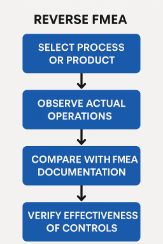
This process should first be completed at the equipment manufacturer and then after final installation on the organisation’s plant floor.
It is a structured method where cross-functional teams review the FMEA backwards by:
- Visiting the actual workplace (Gemba).
- Observing the process live.
- Checking whether preventive and detection controls from the FMEA are actually implemented as described.
- Identifying gaps, new risks, or changes not captured in the original FMEA.
- Updating the FMEA to reflect the current reality.
Read More: https://bit.ly/DiagramTurtleDiagram (What is a Turtle Diagram)
Key Purpose of Reverse FMEA
The key intent is to understand the end objective in terms of Productivity, Process Capability, Timing, and Cost & whether the organisation has been able to/will be able to achieve the desired output.
- To ensure the FMEA is alive, not just a document.
- To detect unnoticed risks, deviations, or nonconformities.
- To verify the effectiveness of controls.
- To catch process drifts
- To reduce customer complaints and internal rejections.
Read More: https://bit.ly/APQPPhase4 (APQP Phase 4)
Where can Reverse FMEA be used?
- Equipment Manufacturer end
- Organisation manufacturing (assembly, machining, moulding, fabrication)
- Service processes where FMEA is applied
Read More: https://bit.ly/APQPPhase5 (APQP Phase 5)
Example of Reverse FMEA
If your FMEA says:
- Operator checks torque every 50 parts
- Alarm triggers if torque drops
- Control plan says the tool gets calibrated monthly
Reverse FMEA will check on the shop floor:
- Is the operator really checking every 50 parts?
- Is the torque tool functioning and calibrated?
- Is there any new failure mode not captured earlier?
- Is the actual process different from the documented process?
If gaps are found → Update FMEA + improve process.
Read More: https://bit.ly/ControlPlan2024 (Control Plan 1st Edition 2024)
Linkage with OEM CSR
| OEM | CSR / Supplier-Requirement Document | What they require (w.r.t Reverse FMEA) |
| Ford Motor Company | Ford Customer Specific Requirements for IATF 16949 | Requires a “reverse FMEA process” — a shop-floor validation for new launches / new tooling / new processes. |
| Stellantis | Stellantis Customer-Specific Requirements (CSR) for use with IATF 16949 | CSR explicitly states: “There is a Reverse PFMEA (proactive approach) process in place … Reverse PFMEA activities are scheduled and tracked.” |
| General Motors (GM) | GM Customer Specific Requirements for IATF 16949 | The annual (or regular) PFMEA review for critical/safety/high-risk items must “incorporate tools such as reverse PFMEA or other similar methods”. |
| Renault Group (and previously PSA Group/part of Stellantis lineage) | Renault CSR for IATF 16949 — as listed by IATF Global Oversight (latest published 2025) | Sources that compile Reverse-FMEA requirements count Renault (PSA) among those requiring Reverse FMEA / PFMEA updating activities. |
Key Benefit
- Reduces real-life failure risks
- Improves customer satisfaction
- Strengthens process robustness
- Keeps FMEA updated and relevant
- Enhances operator awareness and process discipline
Read More: https://bit.ly/OEECalculation (What is OEE?)
Read More: https://bit.ly/PESTLEANALYSIS (What is PESTLE?)
Conclusion:
Reverse FMEA enhances process reliability by validating real-world controls, identifying hidden risks, and ensuring the FMEA consistently reflects current operational reality. It keeps the FMEA alive, closing gaps between paper and practice. It also ensures that what is written in the FMEA is truly happening on the shop floor, driving robust quality and fewer failures. Moreover, it verifies controls in actual conditions, identifies deviations early, and enhances the effectiveness of the entire risk-management system.
Read More: https://bit.ly/7ProblemSolvingTechnique (What is Problem Solving Technique?)
Read More: https://bit.ly/4MChanges (What is 4M change?)
Present Challenges:
- How often is CFT aware of the customer-specific requirements stated by OEMs related to Reverse FMEA?
- How often have organisations understood and implemented Reverse FMEA as part of continual improvement?
References:
FMEA AIAG/VDA 1st Edition 2019
APQP 3rd Edition March 2024
IATF 16949
Customer CSR
Industry Experts
This is the 244th article in my Quality Management series. Each weekend, I share practical insights designed to make your Management System journey more effective, efficient, and meaningful. If you find this useful, please share it with your colleagues as well.
As Albert Einstein wisely said, “The important thing is never to stop questioning.” So, feel free to ask anything related to today’s topic. Your questions spark learning for everyone. I will respond to every query to the best of my ability, and your personal information will always remain confidential.
Your honest feedback matters greatly. Do share your thoughts, and feel free to suggest topics you’d like me to cover in the coming weeks.
Leave a Reply
You must be logged in to post a comment.