“The real question is not how many KPIs we have, but whether they measure what matters.”
Introduction
Consider a student preparing for a competitive medical examination. The objective is to qualify and secure a medical seat. The steps may include study hours, mock-test scores, syllabus completion, revision frequency and accuracy. These measures indicate progress, but achieving them does not guarantee success.
“Being busy is not the same as making progress. KPIs should measure progress towards the KRA, not simply activity.”
Objective and Significance
KRA defines strategic focus areas guiding where effort belongs; KPI measures progress and how well it’s achieved, enabling top management to align vision, track execution, and drive accountable, results-oriented organisational performance.
Read More: https://youtu.be/1ND0kUDuO-k (Balanced Scorecard)
Definition: ISO 9000
Vision: of what an organisation would like to become as expressed by top
management
Mission: The organisation’s purpose for existing as expressed by top management.
Strategy: Plan to achieve a long-term or overall objective.
Read More: https://youtu.be/3aeV9N8io4A (DWM)
In today’s competitive business environment, top management is expected to drive sustainable growth, profitability, operational excellence, and stakeholder satisfaction. Achieving these objectives requires not only clarity on what the organisation must accomplish but also visibility into how progress is being measured.
An organisation may have hundreds of KPIs, dashboards full of data and performance reviews every quarter. Yet, senior leaders may still struggle to answer one basic question: Are our people working on what matters most to the business?
The problem is often not the absence of measurements. It is the confusion between what an individual or function is responsible for and how that responsibility is measured.
From the top-management perspective, the sequence should be:
Business Strategy → Strategic Priorities → KRAs → KPIs → Results
Example:
Suppose a company’s strategic priority is improving customer retention.
The Customer Service function may have a KRA such as “Strengthen customer relationship and service effectiveness.”
KPIs could then include customer retention rate, complaint resolution time, repeat complaints and customer satisfaction score.
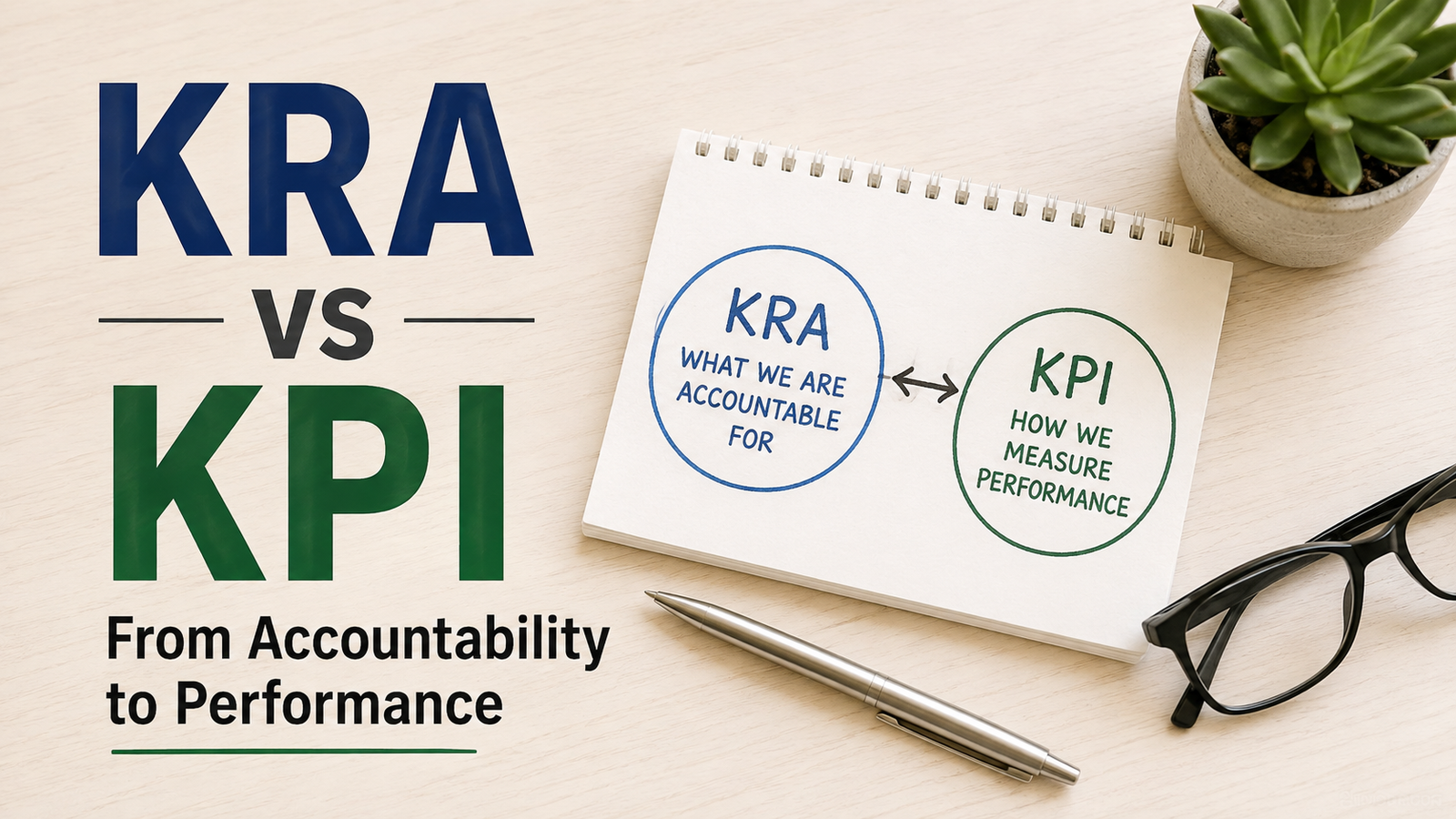
KRA defines the expected contribution; KPI provides evidence of performance.
Read More: https://youtu.be/2e4ubL8eHns (KAIZEN)
What is KRA?
Key Result Areas (KRAs) are the critical domains in which an organisation, business unit, or leader must achieve results to fulfil strategic objectives.
KRAs answer the fundamental question:
“What are the most important outcomes that we are accountable for?”
KRAs are generally broad, strategic, and outcome-oriented.
- Revenue Growth
- Profitability
- Customer Satisfaction
- Operational Excellence
- Employee Development
- Corporate Governance
Read More: https://youtu.be/zqIQbPWlBf8 (Hoshin Kanri)
What is KPI?
Key Performance Indicators (KPIs) are quantifiable measures used to evaluate performance and progress within a specific KRA.
KPIs answer the question:
“How will we measure success?”
For example, if profitability is a KRA, related KPIs may include:
- EBITDA Margin
- Net Profit Margin
- Return on Capital Employed (ROCE)
- Cost Reduction Percentage
KPIs are specific, measurable, and regularly monitored by management.
Example: KRA and KPI
|
KRA |
Safety & Compliance |
Customer Satisfaction |
Cost Competitiveness |
Operational Excellence
|
| KPI | Lost Time Injury= 0 | Customer Complaints = 0 | Conversion Cost Reduction = 3% | OEE ≥ 85% |
| Safety Audit Score > 95% | On-Time Delivery > 98%
|
Energy Cost Reduction = 5%
|
Production Plan Adherence > 98% | |
| Regulatory Compliance = 100% | Warranty Claims Reduction | Inventory Turns > 12
|
Defects < 500 ppm |
Read More: https://youtu.be/YEmgK_tR03A (Vision vs Mission)
Linkage of KRA and KPI:
Board of Directors KRAs:
- Growth
- Profitability
- Governance
- Sustainability
CEO KRAs and KPIs:
- KRA: Increase shareholder value
- KPI: ROCE (Return on Capital Employed) > 20%, EPS growth (Earning Per Share) > 12%
Functional Heads KRAs and KPIs:
- KRA: Increase profitability
- KPI: Manufacturing Cost Reduction = 5%
- KPI: OEE > 70%
- KPI: Scrap Rate < 0.5%
Read More: https://youtu.be/Hb9HiaJpwJU (Business Plan vs Objectives)
Key Differences:
| Aspect | KRA | KPI | Example |
| Focus | What an individual/function is expected to deliver | How performance is measured | KRA: Improve Profitability
KPI: Achieve EBITDA Margin of 15% |
| Purpose | Defines responsibility and contribution | Measures progress and results | KRA: Customer Satisfaction
KPI: Customer Retention Rate > 95% |
| Link | Derived from roles and business priorities | Derived from KRAs and desired outcomes | KRA: Increase shareholder value
KPI: EPS growth (Earnings Per Share) > 12% |
| Question answered | “What am I accountable for?” | “How well am I performing?” | KRA: Operational Excellence
KPI: OEE > 80% |
| Measurement | May not itself be directly measurable | Must be measurable | KRA: Improve customer satisfaction
KPI: %customer retained |
Read More: https://youtu.be/ulSoIVzopyc (OKR vs MBO)
How KRAs and KPIs Work Together
KRAs and KPIs are not alternatives; they are complementary elements of an integrated performance management system.
The relationship can be viewed as follows:
Business Strategy → KRAs → KPIs → Performance Results
For example:
Strategic Objective: Increase shareholder value
KRA: Improve business profitability
KPIs:
- EBITDA Margin > 15%
- ROCE > 20%
- Cost Reduction of 5%
Without KRAs, organisations may lack strategic focus. Without KPIs, they may struggle to measure progress objectively.
Read More: https://youtu.be/ZkVyeOOq8jk (Management by Objectives)
Summary:
KRAs define the destination, while KPIs measure the journey toward reaching it.
- KRAs tell top management where the organisation must deliver results.
- KPIs tell top management whether those results are being achieved and at what pace.
- A single KRA can have multiple KPIs, but every KPI should support a KRA.
Organisations that clearly link KPIs with KRAs are better positioned to translate strategy into measurable business results and sustainable growth.
Read More: https://youtu.be/CRDZLoRJrwk (CR vs CSR)
References:
IATF 16949
Industry Experts
This is the 257th article in my Quality Management series. Each weekend, I share practical insights designed to make your Management System journey more effective, efficient, and meaningful. If you find this useful, please share it with your colleagues as well.
As Albert Einstein wisely said, “The important thing is never to stop questioning.” So, feel free to ask anything related to today’s topic. Your questions spark learning for everyone. I will respond to every query to the best of my ability, and your personal information will always remain confidential.
Your honest feedback matters greatly. Do share your thoughts, and feel free to suggest topics you’d like me to cover in the coming weeks.