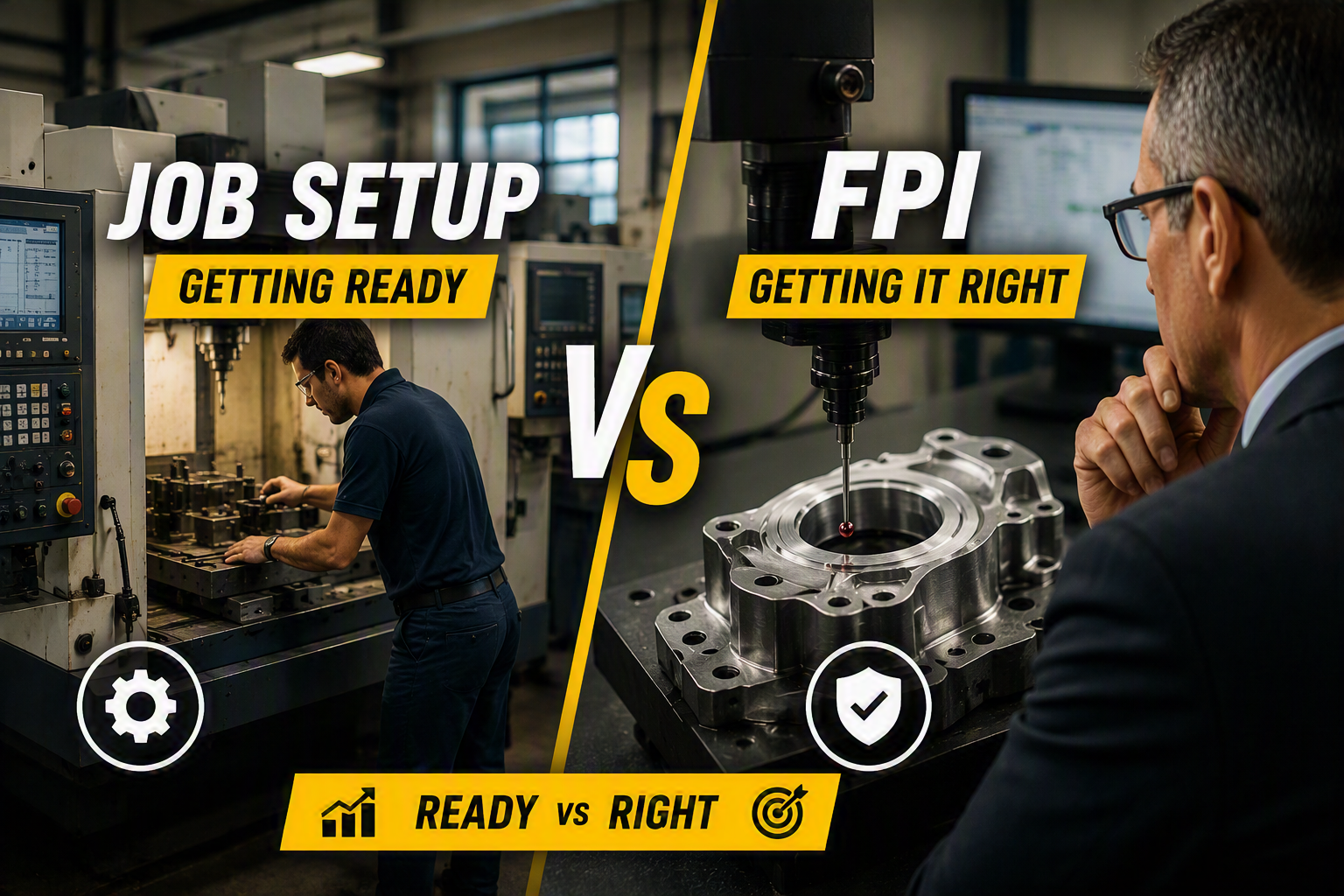
“Before we ask whether the product is good, we should ask whether the process was set up to make a good product.”
Introduction
Before preparing a special meal for a holiday, the mother makes sure that she has all the necessary ingredients: spices, vegetables, fruits, and other items. She then prepares the meal and, before serving it to the family, checks the taste, salt, consistency, and whether the vegetables are properly cooked. Only when she is satisfied with the result does she serve the meal.
Objective and Significance
The customer’s key expectations are to receive the right material, at the right quality and quantity, at a competitive cost. To meet these expectations consistently, the organisation must design and maintain manufacturing processes that are stable, efficient and cost-effective.
An effective Job Setup and First-Piece Inspection (FPI) process plays a critical role in achieving consistent results by ensuring that the process is correctly prepared and that the first part meets the required specifications before production continues.
Read More: https://youtu.be/W1dq3L8FOJc (Customer Complaint Management)
Definition: ISO 9000
Non-Conformity: Non-fulfilment of a requirement
Defect: Non-conformity related to an intended or specified use
Conformity: Fulfilment of a requirement
Capability: Ability of an object to realise an output that will fulfil the requirements for that output.
Read More: https://youtu.be/eBP7noTTOeo (Control of NC Products)
The strength of a manufacturing facility depends on its ability to consistently deliver the required quality and quantity to meet customer expectations. To achieve this sustainably, the organisation needs a robust system that ensures clear understanding of customer requirements, competent manpower, stable manufacturing processes, and consistent supplier inputs.
An effective Job Setup and First-Piece Inspection (FPI) process provides an important layer of control, helping the organisation identify and address potential issues before mass production begins. This enables consistent delivery, reduces defects and supports sustained customer satisfaction.
Read More: https://youtu.be/2e4ubL8eHns (KAIZEN)
Job Setup = Operational Efficiency
- Ensures the process is ready to run efficiently.
- Focuses on reducing setup time and maximising machine availability.
- Directly affects productivity, output, and delivery commitments
Read More: https://youtu.be/sPtwvL1igLE (Final Inspection)
First Part Inspection = Quality Gate
- Acts as the final checkpoint before volume production.
- Prevents large-scale defects and customer escapes.
- Reduces scrap, rework, warranty costs, and quality risks.
Real-Life Example:
Machining a Brake Disc
Imagine a machine shop producing brake discs for cars.
Job Setup: “Are we ready to make the part?”
Before production starts, the operator checks (based on 4M):
- Qualified and competent operator (Man)
- Correct machine (Machine)
- Correct fixture (Machine)
- Correct cutting tools (Machine)
- Correct gauges (Machine)
- Correct raw material (Material)
- Correct drawing and revision (Method)
- Correct CNC program (Method)
- Correct machine parameters (Method)
- Correct work instructions (Method)
The question is:
“Have we set everything correctly to produce the required brake disc?”
First Part Inspection: “Did we actually make the right part?”
The operator produces the first brake disc.
Quality/authorised personnel then check critical characteristics such as:
- Outer diameter
- Thickness
- Bore diameter
- Bolt-hole position
- Runout
- Surface condition
If everything is within specification, production is released.
The question is:
“Has our setup actually produced a part that meets the requirements?”
The objective is not to inspect more.
It is to prevent a setup mistake from becoming a large-scale production problem.
Read More: https://youtu.be/Zi7UzM59Muw (Reaction Plan)
Key Difference:
| Aspect | Job Setup | First Part Inspection |
| Purpose | Prepare the machine/process correctly | Confirm the first output meets requirements |
| When | Before production starts | After setup, before/at the start of production |
| Focus | Process readiness | Product conformity |
| Key question | “Have we set the process correctly?” | “Have we produced the right part correctly?” |
| Typical controls | Tooling, fixtures, programs, parameters, material, work instructions | Dimensions, specifications, appearance, functional characteristics |
| Management risk controlled | Wrong setup → wrong production | Wrong first part → repeated defects |
| Business impact | Prevents downtime, rework and instability | Prevents mass production of nonconforming parts |
Read More: https://youtu.be/ZNlr1yEpVbw (SMED)
How to check the Effectiveness?
Rather than checking individual inspection records, the key focus should be to look at system-level indicators:
Job Setup:
- Setup Time
- Changeover Time (SMED- Single-Minute Exchange of Dies)
- OEE (Overall Equipment Effectiveness)
First Piece Inspection:
- First Pass Yield
- Rejection Rate
- COPQ (Cost of Poor Quality)
- Customer complaints traceable to setup errors
The real objective is not more inspection. It is better process readiness with early confirmation.
In simple terms:
Job Setup prevents the wrong process. First Part Inspection prevents the wrong process from becoming mass production.
Read More: https://youtu.be/QetaKIrQB5A (OEE)
Industry Challenges:
- Rushed Changeovers
- Inconsistent Setup and first-piece inspection Standards
- Operator skill variability
- Documentation fudging
Summary:
Job Setup ensures we are ready to produce.
First Part Inspection ensures we are ready to produce correctly.
A strong manufacturing system requires both:
- Efficient Job Setup to achieve productivity.
- Robust First Part Inspection to ensure quality from the first piece onward.
This combination supports top management goals of Productivity, Quality, Cost, Delivery, Safety, and Morale (PQCDSM)
Read More: https://youtu.be/pJ2Pg6UH6RI (4M Change)
References:
IATF 16949
Industry Experts
This is the 258th article in my Quality Management series. Each weekend, I share practical insights designed to make your Management System journey more effective, efficient, and meaningful. If you find this useful, please share it with your colleagues as well.
As Albert Einstein wisely said, “The important thing is never to stop questioning.” So, feel free to ask anything related to today’s topic. Your questions spark learning for everyone. I will respond to every query to the best of my ability, and your personal information will always remain confidential.
Your honest feedback matters greatly. Do share your thoughts, and feel free to suggest topics you’d like me to cover in the coming weeks.