“When speed overrides stability, and pressure overrides capacity, failure is not a risk, it’s a certainty.” – Taiichi Ohno
Introduction
In our childhood and later years, we all appeared for exams and achieved results. Most of us studied intensively and with anxiety in the last few days, weeks, or months and performed accordingly. A few, however, studied consistently, with plan, throughout the year and also achieved strong results, perhaps with a slight increase in effort closer to exams.
So, who is the real winner?
Which approach would we want our children to follow and why?
Content: 3M
- What is 3M?
- The key purpose of 3M
- Example of 3M implementation
- Key Benefits
- Present Industry challenges
- Conclusion
Read More: https://youtu.be/4ZgUCVvgsWg (Fault Tree Analysis)
Read More: https://youtu.be/xbuD1FePP5s (Problem Solving Techniques)
Objective
The key objective of 3M is not just efficiency, it is creating a system where work flows smoothly, people thrive, and waste disappears naturally. Lean success comes from eliminating waste (Muda), smoothing flow (Mura), and avoiding overload (Muri).
Waste is not the only problem, imbalance and overburden are root causes.
After reading the article, you will understand the meaning of 3M, its purpose, related examples, key benefits and present industry challenges.
Read Morehttps://youtu.be/-1jZVaAu-X8 (Causal Factors)
Read More: https://youtu.be/qoAvb6HnF-A (SWOT Analysis)
Definition:
Heijunka: It is the practice of smoothing and leveling production volume and product mix over a period of time to create a steady, predictable workflow.
SMED (Single Minute Exchange of Dies): it is a Lean method used to reduce machine changeover time so that switching from one product to another takes less than 10 minutes.
Standardized Work: it is the documented best method to perform a job safely, efficiently, and consistently using the least waste.
Takt time: It is the rate at which a product must be produced to meet customer demand.
Read More: https://youtu.be/F2zVsEbbILA (DOJO Room)
Read More: https://youtu.be/2e4ubL8eHns (Kaizen)
Detailed Information
The concepts of Muda, Mura, and Muri (3M) come from Toyota and are part of the Toyota Production System (TPS), developed in post-World War II Japan.
Japan had scarce resources, limited capital, and low demand. The focus shifted from mass production to maximum efficiency with minimal resources.
Read more: https://youtu.be/bUGzXAQSsJU (5S)
Read More: https://youtu.be/MzzQFm9paJw (Quality Circle)
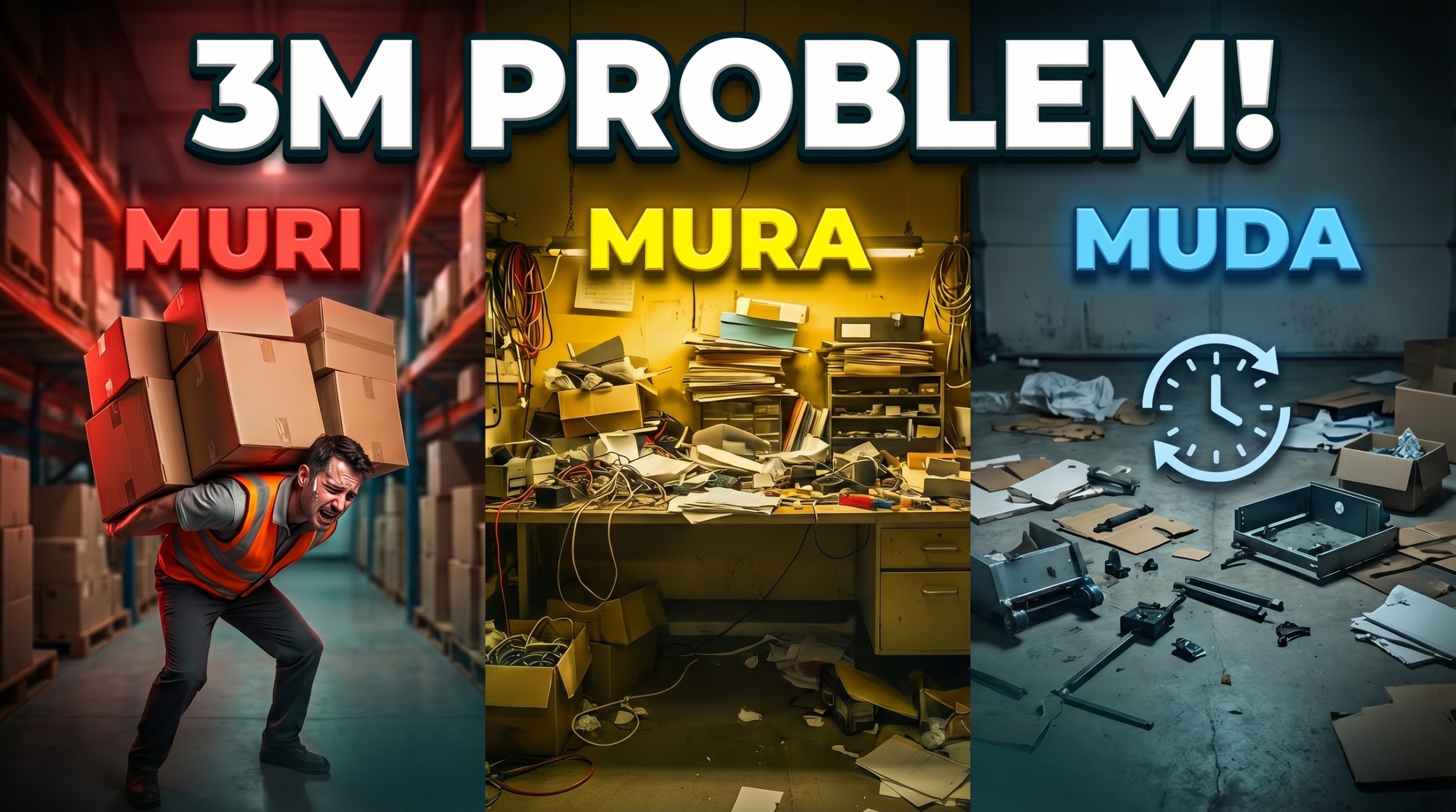
What is 3M?
The 3M concept was born out of scarcity, but it became a universal philosophy of efficiency.
Muda (Waste)
- Meaning: Any activity that does not add value to the customer
- Examples:
- Waiting time
- Excess inventory
- Rework / defects
- Unnecessary movement
In simple words: “Doing work that customers don’t care about.”
Mura (Unevenness / Imbalance)
- Meaning: Irregular or inconsistent flow of work
- Examples:
- Sudden rush orders followed by idle time
- Uneven workload across teams
In simple words: “Sometimes too much work, sometimes too little.”
Muri (Overburden)
- Meaning: Overloading people or machines beyond capacity
- Examples:
- Employees working excessive overtime
- Machines running continuously without rest
In simple words: “Pushing beyond limits.”
Read More: https://youtu.be/3aeV9N8io4A (DWM- Daily Work Management)
Key Purpose of 3M
The purpose of 3M is to create a smooth, efficient, and sustainable process by eliminating waste, removing imbalance, and avoiding overburden.
Relationship
- Mura (imbalance) → creates Muri (overburden)
- Muri (overburden) → leads to Muda (waste)
So, solving only waste is not enough, we must fix all three.
Read More: https://youtu.be/BeLWXihzdh0 (Difference Between PDCA and SDCA)
Read More: https://youtu.be/zqIQbPWlBf8 (Hoshin Kanri)
Examples of 3M Framework
Example 1: Mumbai Dabbawallas
The famous Mumbai Dabbawallas are a perfect real-life example of Muda, Mura, and Muri (3M), even though they never formally studied Lean!
Muda (Waste) – Almost Zero (objective)
- No digital systems, no complex paperwork
- Minimal handling, no unnecessary movement
- Very low errors (near Six Sigma level)
👉 They remove everything that doesn’t add value, simple, fast, efficient.
Mura (Unevenness) – Well Balanced (objective)
- Tiffin are collected, sorted, and delivered in fixed time slots
- Workload is evenly distributed across workers
- Standardized coding system ensures smooth flow
👉 No chaos, no sudden spikes, everything runs like clockwork.
Muri (Overburden) – Avoided (objective)
- Each worker carries a manageable number of tiffin
- Work is divided across multiple stages (collection → sorting → delivery)
- No one is overloaded
People are not pushed beyond limits, hence consistent performance.
In short, They mastered Lean without jargon, by focusing on discipline, simplicity, and flow.
Example 2: Production Planning
- Mura: Fluctuating production plan due to last-minute order changes.
Objective: Producing the same quantity every day
Situation
- Monthly demand = 2,000 cars
- Working days = 20
- Heijunka production = 100 cars/day
❌ Not:
- 300/day at month-end
- 40/day at start
- Muri: Workers rush to meet targets, machines run nonstop
- Uneven working hours for the operator and supervisor
- No time for preventive and predictive maintenance
- Muda: Defects, rework, excess inventory, downtime
- High internal rejection
- Frequent machine breakdown
- Low employee morale
- Low inventory turnover
Eliminating Mura first often prevents Muri and reduces Muda.
Read More: https://youtu.be/jPXHLizqzM8 (Obeya Room)
Read More: https://bit.ly/3Gemba (3G: Genma, Genbutsu, Genjitsu)
Key Benefit
3M converts hidden inefficiencies into visible business gains: cost, speed, quality, and people performance
- Quality improves
- Costs reduce
- Productivity increases
- Employee stress decreases
| 3M Focus |
|
|
| Muda ↓ |
|
|
| Mura ↓ |
|
|
| Muri ↓ |
|
|
In short: Better results with less effort and fewer problems
Read More: https://bit.ly/OEECalculation (What is OEE?)
Read More: https://bit.ly/PESTLEANALYSIS (What is PESTLE?)
Conclusion:
3M (Muda, Mura, Muri) is a Lean concept from the Toyota Production System focused on improving efficiency. It eliminates waste (Muda), reduces unevenness (Mura), and avoids overburden (Muri). Together, they create smooth processes, improve quality, lower costs, and enhance productivity while ensuring sustainable workloads for people and systems.
Read More: https://bit.ly/7ProblemSolvingTechnique (What is Problem Solving Technique?)
Read More: https://bit.ly/4MChanges (What is 4M change?)
Present Challenges:
- To effectively implement the 3M framework, machines must operate consistently and deliver quality output. However, how often do organizations prioritize condition-based monitoring, preventive maintenance, and the availability of critical spare parts? Are these truly focus areas for top management?
- To ensure consistent operator performance, a supportive work environment, reasonable working hours, and adequate resources (measuring instruments, work instructions, and training) are essential. But how frequently does top management review and ensure compliance with these requirements?
References:
IATF 16949
Toyota Production System
Industry Experts
This is the 246th article in my Quality Management series. Each weekend, I share practical insights designed to make your Management System journey more effective, efficient, and meaningful. If you find this useful, please share it with your colleagues as well.
As Albert Einstein wisely said, “The important thing is never to stop questioning.” So, feel free to ask anything related to today’s topic. Your questions spark learning for everyone. I will respond to every query to the best of my ability, and your personal information will always remain confidential.
Your honest feedback matters greatly. Do share your thoughts, and feel free to suggest topics you’d like me to cover in the coming weeks.
Excellent peace of information with right understandable examples. Thank you Bhavya Mangala Ji
Thanks Tushar for your kind words