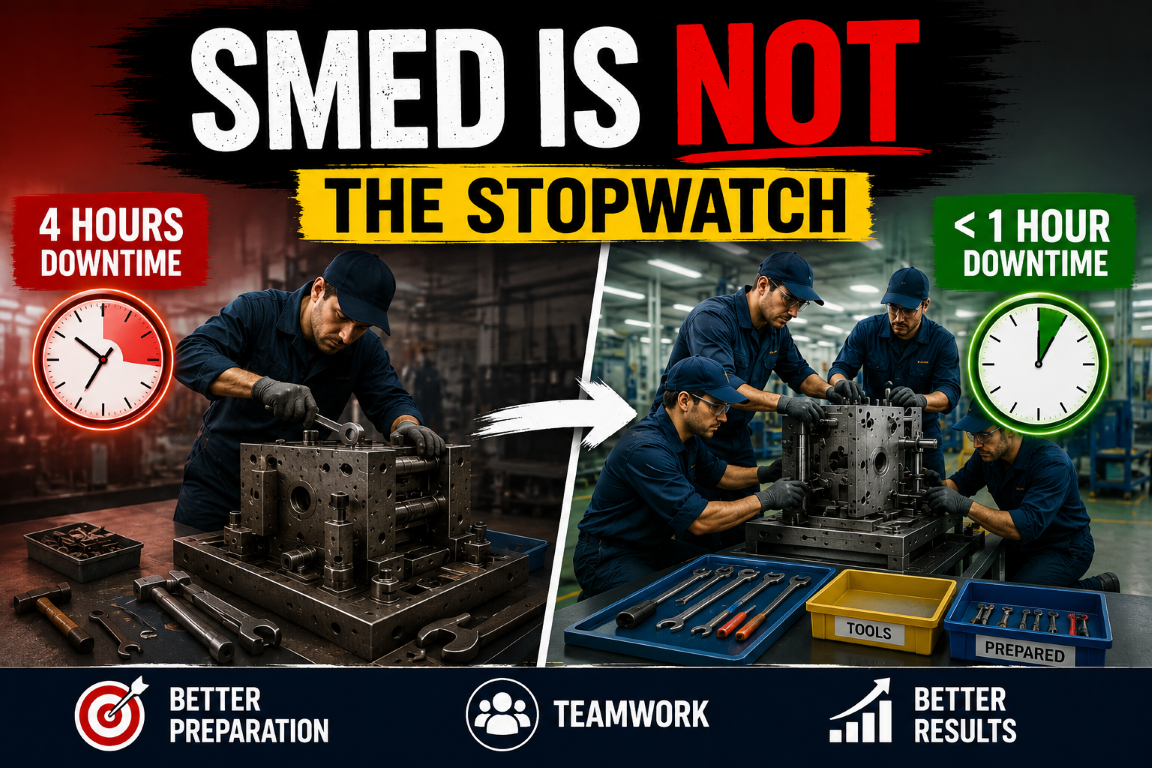
“The hardest part of SMED is not the stopwatch: it is the mindset.”
Introduction
Whenever guests come to our home, we can prepare dinner in two ways. In the first approach, a single person takes full responsibility and works throughout the day to get everything ready, including cleaning, shopping, and cooking.
In the second approach, the work is shared among family members. For example, one person cuts the salad, another buys vegetables and sweets at the market, someone cleans the house, and someone else handles the kitchen. By dividing tasks, the same work can be finished in just a couple of hours.
Read More: https://bit.ly/MudaMuriMura (3M- Muda, Mura, Muri)
Read More: https://bit.ly/MUDA8Waste (Muda: 8 Wastages)
Read More: https://bit.ly/SMED- (SMED)
Objective and Significance of SMED
The primary objective of SMED is to utilise resources optimally and achieve the best possible results. Its importance is increasing every year, as customers continuously demand cost reduction without compromising on quality and delivery. Faster changeovers enable smaller batch sizes, reduced inventory, and improved operational flexibility.
What You Will Learn
After reading the article, you will understand:
- The meaning of SMED
- Why it is important
- The key steps involved
- An example of die changeover
- The difference between internal and external activities
- The major benefits of SMED
- The current challenges faced in the industry
Read More: https://bit.ly/MuraMuri (Mura and Muri)
Read More: https://youtu.be/qoAvb6HnF-A (SWOT Analysis)
Definition:
Heijunka: It is the practice of smoothing and levelling production volume and product mix over a period of time to create a steady, predictable workflow.
SMED (Single Minute Exchange of Dies): It is a Lean method used to reduce machine changeover time so that switching from one product to another takes less than 10 minutes.
Standardised Work: it is the documented best method to perform a job safely, efficiently, and consistently using the least waste.
Takt time: It is the rate at which a product must be produced to meet customer demand.
Read More: https://youtu.be/F2zVsEbbILA (DOJO Room)
Read More: https://youtu.be/2e4ubL8eHns (Kaizen)
Detailed Information
SMED stands for Single-Minute Exchange of Die, a lean manufacturing methodology developed by Shigeo Shingo at Toyota in the 1950s–70s.
Despite the name, “single-minute” doesn’t mean changeovers must take exactly one minute; it means they should take less than 10 minutes (i.e., a single-digit number of minutes).
Read more: https://youtu.be/bUGzXAQSsJU (5S)
Read More: https://youtu.be/MzzQFm9paJw (Quality Circle)
Why is SMED needed?
In a traditional setup, the thought process is that,
- Because changeovers take too long, we make large batches.
- Because we make large batches, we hold a huge inventory.
- Because we hold a huge inventory, we are slow, costly, and inflexible.
SMED is needed because in today’s world, the factory that changes fastest wins, and long changeovers are the single biggest obstacle to that speed.
Read More: https://youtu.be/3aeV9N8io4A (DWM- Daily Work Management)
Read More: https://youtu.be/4ZgUCVvgsWg (Fault Tree Analysis)
The Two Key Concepts
Internal setup: tasks that can only be done while the machine is stopped (e.g., physically swapping a die or tool).
External setup: tasks that can be done while the machine is still running (e.g., pre-staging tools, pre-heating dies, gathering documents).
The Four Steps of SMED
- Observe: Document the current changeover process in detail (often by video).
- Separate: Identify which activities are internal vs. external.
- Convert: Move as many internal tasks to external as possible.
- Streamline: Optimise all remaining steps (standardise, use quick-release clamps, checklists, parallel work, etc.).
Read More: https://youtu.be/BeLWXihzdh0 (Difference Between PDCA and SDCA)
Read More: https://youtu.be/zqIQbPWlBf8 (Hoshin Kanri)
Steps to Effectively Implement SMED
A factory produces plastic moulded components. It needs to switch from making Part A (blue plastic caps) to Part B (red plastic bottles). This requires changing the mould (die) in the injection moulding machine.
Original changeover time: 4 hours
Step 1: OBSERVE – What Happens Currently (Before SMED)
Everything is done after the machine stops:
| # | Activity | Time |
| 1 | The operator walks to the tool storage to fetch a new mould | 15 min |
| 2 | Waits for crane/forklift to become available | 20 min |
| 3 | The machine cools down | 30 min |
| 4 | Old mould removed | 25 min |
| 5 | New mould installed and bolted | 30 min |
| 6 | The operator goes to get the correct material (red plastic) | 20 min |
| 7 | Purge old blue plastic from the barrel | 25 min |
| 8 | Set new temperature/pressure parameters on the machine | 20 min |
| 9 | Trial run and quality check | 30 min |
| 10 | Adjust settings based on trial run | 25 min |
| Total | ~4 hours |
Step 2: SEPARATE – Internal vs. External
| Activity | Type | Reason |
| Fetch a new mould from storage | ❌ Currently Internal → Should be External | Can be done before the machine stops |
| Wait for the crane | ❌ Currently Internal → Should be External | Schedule a crane in advance |
| The machine cools down | ✅ Internal | The machine must be stopped |
| Remove old mould | ✅ Internal | The machine must be stopped |
| Install a new mould | ✅ Internal | The machine must be stopped |
| Fetch red plastic material | ❌ Currently Internal → Should be External | Can be staged in advance |
| Purge old material | ✅ Internal | The machine must be stopped |
| Set new parameters | ❌ Currently Internal → Should be External | Parameters can be pre-programmed |
| Trial run & quality check | ✅ Internal | Needs a machine running on a new setup |
| Adjust settings | ✅ Internal | Needs a machine running |
Step 3: CONVERT – Move Internal to External
Before the machine even stops, the operator now does:
| Activity (Done While Machine Still Runs) | Time Saved |
| Fetches a new mould and stages it next to the machine | 15 min |
| Books crane 1 hour in advance | 20 min |
| Retrieves red plastic and places it at the workstation | 20 min |
| Pre-program new temperature/pressure settings in the controller | 20 min |
75 minutes moved outside the machine stoppage window.
Step 4: STREAMLINE – Optimise What Remains
Even the remaining internal tasks are improved:
| Improvement | Old Way | New Way | Saved |
| Use quick-release clamps instead of bolts | 30 min to bolt mould | 10 min with clamps | 20 min |
| Use standardised mould heights | Custom shimming each time | No adjustment needed | 10 min |
| Two operators work in parallel during changeover | 1 operator sequential | 2 operators in parallel | 15 min |
| Pre-set trial run parameters (known from last time) | 30 min trial + 25 min adjust | 15 min trial + 10 min adjust | 30 min |
Final Result
| Phase | Before SMED | After SMED |
| External (pre-setup) | 0 min | 30 min (done while running) |
| The machine stopped time | 4 hours | 52 min |
| Total elapsed time | 4 hours | 4 hours (but machine downtime slashed) |
The machine is now stopped for less than 1 hour instead of 4 hours — a 75%+ reduction in downtime.
Key Takeaway
| Internal | External | |
| Definition | Done while the machine is stopped | Done while the machine is running |
| Goal | Minimise and streamline | Maximise – shift as much here as possible |
| Examples | Remove old mould, purge material, and trial run | Fetch mould, stage materials, and pre-program settings |
The golden rule of SMED: “Never let the machine wait for the operator, let the operator wait for the machine.”
Common Pitfalls to Avoid
Even well-planned SMED events can fail to deliver lasting changes if these traps aren’t addressed:
- Not involving operators:
- Skipping video analysis
- Focusing only on big fixes
- Ignoring documentation and training
- Treating SMED as a one-time event
Read More: https://youtu.be/jPXHLizqzM8 (Obeya Room)
Read More: https://bit.ly/3Gemba (3G: Genma, Genbutsu, Genjitsu)
Key Benefit
- Enables just-in-time (JIT) production
- Reduces downtime and waste
- Allows manufacturers to respond faster to demand changes
- Supports smaller, more frequent production runs without sacrificing efficiency
- OEE (Overall Equipment Effectiveness) is the best metric to measure SMED success; by reducing changeovers, companies reclaim lost Availability and eliminate trial-and-error adjustments that cause scrap, improving Quality.
A classic analogy is a Formula 1 pit stop, through careful preparation and parallel teamwork, what once took minutes has been reduced to under 3 seconds. SMED applies the same thinking to factory floors.
Read More: https://bit.ly/OEECalculation (What is OEE?)
Read More: https://bit.ly/PESTLEANALYSIS (What is PESTLE?)
Conclusion:
SMED relies on a culture embracing continuous improvement; a lack of engagement from upper management, production teams, or support groups can undermine efforts.
SMED isn’t just a company benefit; for the operator, it means a calmer, safer, more skilled, and more respected role on the shop floor. The operator stops being a passive executor and becomes an active contributor to how the factory performs.
SMED is not just a tool; it’s a mindset shift
The golden rule of SMED: SMED fails when it is treated as a one-time event. It succeeds when it becomes a way of thinking.
Read More: https://bit.ly/7ProblemSolvingTechnique (What is Problem Solving Technique?)
Read More: https://bit.ly/4MChanges (What is 4M change?)
Present Challenges:
Resistance to Change is the biggest Barrier. “We’ve always done it this way” is the most common phrase heard on the shop floor.
- Operators fear that SMED will make their skills redundant or less valued
- Supervisors worry about losing control of their area
- Management hesitates to invest time in improvement when production pressure is high
“The hardest part of SMED is not the stopwatch: it is the mindset.”
References:
IATF 16949
Toyota Production System
Industry Experts
This is the 250th article in my Quality Management series. Each weekend, I share practical insights designed to make your Management System journey more effective, efficient, and meaningful. If you find this useful, please share it with your colleagues as well.
As Albert Einstein wisely said, “The important thing is never to stop questioning.” So, feel free to ask anything related to today’s topic. Your questions spark learning for everyone. I will respond to every query to the best of my ability, and your personal information will always remain confidential.
Your honest feedback matters greatly. Do share your thoughts, and feel free to suggest topics you’d like me to cover in the coming weeks.
Bhavji,This article address the SMED Concept in a very simple and easy language .
Keep up this good work.
Thanks Pragnesh for reading the article and appreciating it.